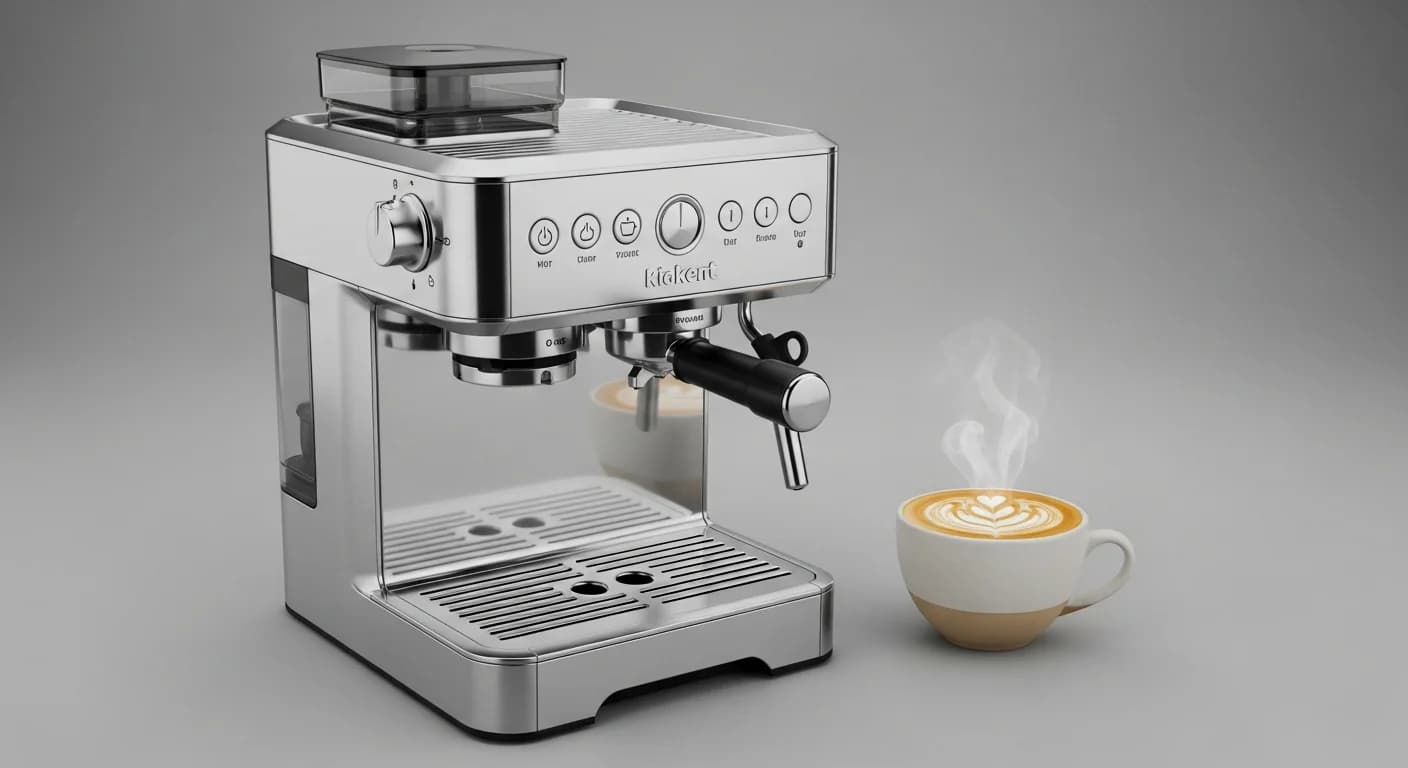
Best Semi-Automatic Espresso Machines 2026 — Top 8 Ranked
PRThis article contains affiliate links
Key Takeaways
- Semi-automatic espresso machines give you full control over grinding, tamping, and extraction — the foundation of real barista skill
- De'Longhi Dedica Arte is the go-to beginner machine; Breville Barista Express adds a built-in grinder for all-in-one convenience
- Gaggia Classic Evo Pro and Rancilio Silvia are prosumer-grade machines built to last a lifetime
If you want real espresso at home — not instant, not capsule — a semi-automatic espresso machine is where to start. Unlike super-automatics, a semi-auto puts grind size, tamping pressure, and extraction time entirely in your hands. Your technique improves over time, and your coffee improves with it.
Here are the 8 best semi-automatic espresso machines available in 2026, ranked by value and performance at every price point.
- ✓Semi-automatic espresso machines give you full control over grinding, tamping, and extraction — the foundation of real barista skill
- ✓De'Longhi Dedica Arte is the go-to beginner machine; Breville Barista Express adds a built-in grinder for all-in-one convenience
- ✓Gaggia Classic Evo Pro and Rancilio Silvia are prosumer-grade machines built to last a lifetime
What to Look for in a Semi-Automatic Espresso Machine
Pump Pressure: 9 Bar Is the Standard
Commercial espresso is extracted at 9 bar of pressure. Most consumer machines advertise "15 bar" — this is the maximum pump rating, not the operating pressure. What matters is consistent, stable extraction at around 9 bar. Don't compare machines on maximum bar ratings alone.
Boiler Type: Single vs. Dual
| Type | Behavior | Best For |
|---|---|---|
| Single boiler | Switch between brew and steam | One or two shots at a time |
| Dual boiler | Brew and steam simultaneously | High-volume use, latte art practice |
Most entry and mid-range machines use single boilers. Dual boilers appear in high-end models.
Portafilter Size: 58mm for Full Compatibility
A 58mm portafilter matches commercial machine standards — giving you access to a wide range of aftermarket baskets, tampers, and accessories. The De'Longhi Dedica uses a 51mm portafilter, which limits accessory options but keeps the machine compact.
PID Temperature Control
PID (Proportional-Integral-Derivative) control stabilizes brew temperature to within ±1°C. Since temperature directly affects espresso extraction quality, PID control is worth paying for if your budget allows.
Top 8 Semi-Automatic Espresso Machines
Price × Skill Ceiling Map — Pick by Where You Want to End Up
"Just starting out" and "a machine I'll use for life" lead to very different choices. Here's the zone breakdown.
| Zone | Price | Representative Models | Best for |
|---|---|---|---|
| ★Entry | About ¥40,000–54,000 | De'Longhi Dedica EC680 / Dedica Arte | Trying out hands-on brewing |
| ★Mid-tier | About ¥180,000 (Amazon Japan, September 2026) | Breville Barista Express | Built-in grinder, fewer extras to buy |
| ★Pro-sumer | About ¥130,000–240,000 | Gaggia Classic Evo Pro / Rancilio Silvia | Commercial-grade quality at home |
| ★Commercial | ¥200,000+ | La Marzocco Linea Mini | A single forever machine |
If you drink multiple cups a day or want to practice latte art seriously, starting in the mid-tier or pro-sumer zone tends to deliver higher long-term satisfaction. For weekend-only use, the entry zone is enough.
1st: De'Longhi Dedica Arte EC885J — The Best Beginner Machine
De'Longhi Japan released the De'Longhi Dedica Arte in April 2023. At 15cm wide, it fits easily on a small kitchen counter, and its double-walled steam wand makes the fine milk foam needed for latte art.
You can choose the extraction temperature from 3 levels to suit the roast. Register with De'Longhi for a 3-year warranty. It comes in Metal Silver, Beige, and Gray; on Amazon Japan on September 19, 2026, only the Beige model was available new (¥53,975).
Pros
- +15cm slim profile fits any kitchen counter
- +Double-layer steam tube enables real latte art practice
- +3-year warranty after De'Longhi family registration
- +Handles both espresso and cappuccino
Cons
- -Extraction temperature is chosen from 3 levels, not set to the degree
- -Only the Beige model was available new on Amazon Japan (September 2026)
2nd: De'Longhi Dedica EC680 — The Proven Entry-Level Classic
The EC680 predates the Dedica Arte but remains a solid entry point. The steam wand is simpler than the EC885J's, but espresso extraction quality is comparable. At ¥39,800 on Amazon Japan (September 2026), it's an affordable way to start pulling shots with a recognized brand.
Pros
- +Under ¥40,000, affordable for a semi-auto
- +Same 15cm slim footprint as the Dedica Arte
- +Long production run means well-documented user community
- +Solid espresso extraction quality
Cons
- -Simpler steam wand makes latte art more challenging
- -No PID
- -51mm portafilter
3rd: Breville Barista Express BES870 — The All-in-One Grinder Machine
The Breville Barista Express is the definitive grinder-integrated espresso machine. A precision conical burr grinder is built directly into the machine, so you go from beans to espresso in under 60 seconds — no separate grinder needed.
A purge function that automatically adjusts water temperature after steaming, a 2L removable water tank, and 1600W Thermocoil heating give you everything an intermediate home barista needs.
Note that the Amazon Japan listing is a refurbished unit. Some buyer reviews say they needed a transformer to match Japan's voltage.
Pros
- +Grinder built in — no separate purchase needed
- +Purge function automatically adjusts water temperature after steaming
- +Removable 2L water tank with handle
- +Sealed 1/2 lb bean hopper
Cons
- -Large and heavy (~8kg) — needs dedicated counter space
- -¥178,000 on Amazon Japan (September 2026) is a significant investment
- -Cleaning and maintenance has a learning curve
4th: Breville Barista Touch Impress BES881 — Flagship with Touchscreen
The Barista Touch Impress is Breville's flagship. The "Impress Puck System" assists with tamping — one of the hardest skills for beginners to master consistently. A large touchscreen lets you choose from 8 café presets or customize up to 8 drinks.
5th: Gaggia Classic Evo Pro — Prosumer Quality at a Fair Price
The Gaggia Classic Evo Pro is the entry point into prosumer-level home espresso. Italian-made with a stainless steam wand, 58mm portafilter, and all-metal construction — this machine is built to last decades. The Japanese model (SIN035R) comes with domestic warranty coverage.
This machine has an enormous online community, extensive aftermarket support, and is a popular base for advanced modifications (OPV spring, PID kit).
Pros
- +58mm portafilter compatible with commercial accessories
- +All-metal construction for exceptional durability
- +Active online community with extensive mod support
- +Japanese domestic warranty included
Cons
- -Requires temperature surfing — no PID standard
- -Steam-to-brew switching requires cooldown time
- -Steeper learning curve than De'Longhi
6th: Rancilio Silvia — The Iconic Single-Boiler Home Espresso Machine
The Rancilio Silvia is a long-selling semi-automatic espresso machine that has been in production for over 20 years. It uses the same group head and steam wand design as commercial Rancilio café machines. Stainless steel construction means it genuinely lasts a lifetime.
A single 12 oz brass boiler handles both brewing and steaming, and a 3-way solenoid valve releases excess pressure. Highly popular as a PID mod base for enthusiasts who want commercial-level temperature control.
However, the Amazon Japan listing specifies 120V. Japanese household outlets supply 100V, so check the power specification before you buy.
Pros
- +20+ year production run — proven long-term reliability
- +Commercial-grade internal components with wide parts availability
- +Excellent PID mod base for precision temperature control
- +Iconic status with global barista community recognition
Cons
- -No PID standard — temperature surfing required
- -Boxy industrial design is polarizing
- -Premium pricing for single-boiler performance
7th: De'Longhi Dedica EC680M — Two-Tone Silver Colorway
The EC680M is the Black × Silver colorway of the EC680. Performance is identical — this is purely a color choice for those who prefer the two-tone silver aesthetic or want to match other silver kitchen appliances.
However, on Amazon Japan on September 19, 2026, this colorway had no new listings, only used ones. If you want it new, the EC680BK in 2nd place is the option.
8th: Gaggia Classic Evo Pro (Industrial Grey) — The Vintage-Industrial Colorway
The grey colorway of the Gaggia Classic Evo Pro gives the machine a rugged, industrial-vintage look that stands out from typical kitchen appliances. Performance is identical to the stainless model — choose based on your aesthetic preference.
However, the product page for this card (model RI9380/51) specifies 120V, and it is a different model from the Japanese SIN035R in 5th place. Japanese household outlets supply 100V, so check the power specification before you buy.
Budget Guide
| Budget | Model | Best for |
|---|---|---|
| Under ¥40,000 | De'Longhi Dedica EC680 | Entry-level, proven |
| Under ¥55,000 | De'Longhi Dedica Arte EC885J | Entry-level with latte art |
| Under ¥130,000 | Gaggia Classic Evo Pro | Prosumer entry, built to last |
| Under ¥180,000 | Breville Barista Express | Grinder included, all-in-one (refurbished listing) |
| Under ¥250,000 | Rancilio Silvia | The iconic lifetime machine (listed at 120V) |
| Under ¥360,000 | Breville Barista Touch Impress | Touchscreen flagship |
Prices are from Amazon Japan as of September 19, 2026.
Semi-Auto vs. Super-Auto: Which to Choose?
Choose a super-automatic if: You want great coffee with minimal effort and no learning curve.
Choose a semi-automatic if: You want to develop real barista skills and enjoy the process of dialing in your espresso.
Semi-autos reward patience and practice. The coffee gets measurably better as your technique improves — that's the appeal.
Final Verdict
In 2026, the semi-automatic espresso machine market is clearly divided: De'Longhi and Breville for entry to intermediate, Gaggia and Rancilio for the serious home barista.
For most beginners, the De'Longhi Dedica EC680 (about ¥40,000) or the Dedica Arte EC885J (about ¥54,000) is the right starting point. If you want to invest in a machine that grows with your skills and lasts decades, the Gaggia Classic Evo Pro (¥129,800 on Amazon Japan, September 2026) is the better long-term choice. For an all-in-one solution, the Breville Barista Express (¥178,000) delivers the most complete package.
Related Articles
- Best Home Espresso Machines Under ¥50,000 — 2026 Guide
- 10 Coffee Gear Picks for 2026: The Best New and Notable Home Brewing Equipment
- Best Automatic Milk Frothers Ranked: 7 Picks for Cappuccinos and Lattes at Home
- 2026 Coffee Gear Editors' Choice: Our Top 10 Picks of the Year
- Best Coffee Makers Under ¥10,000 — Top Value Picks 2026
About the AuthorExpert Reviewed

Coffee Guide Editorial
A team of certified writers and baristas with hands-on experience at origin farms and roasteries. We deliver practical, experience-backed guides on bean selection, brewing methods, and equipment reviews.
Credentials & Experience
- J.C.Q.A. Certified Coffee Instructor
- SCA Certified Barista
- 5+ years running a specialty roasting café
- 200+ coffee beans tasted annually