Best Manual Coffee Grinders: Top Picks and How to Choose the Right One
PRThis article contains affiliate links
Key Takeaways
- Why manual grinders often outperform electric grinders at similar price points
- Four key criteria for choosing the right manual grinder
- Three recommended models ranked with detailed comparisons
If you have been buying pre-ground coffee, you are leaving a significant amount of flavor behind. Ground coffee begins to stale within minutes of grinding as the aromatic compounds inside the bean oxidize rapidly when exposed to air. Grinding fresh — immediately before brewing — is the single most impactful change you can make to improve your daily cup.
Manual coffee grinders make this easy and affordable. A quality hand grinder costs between $20 and $80, requires no electricity, and can produce a grind quality comparable to electric grinders that cost two to three times as much. This guide explains why, and helps you choose the right one.
Why Manual Grinding: The Real Case for Hand Grinders
Coffee quality deteriorates at the moment of grinding, not at the moment of roasting. Inside a whole coffee bean, hundreds of volatile aromatic compounds are preserved in a protected state. When you grind, those compounds are immediately exposed to oxygen and begin to dissipate. Pre-ground coffee loses much of its best flavor within 15–30 minutes of grinding. Freshly ground coffee, brewed within minutes of grinding, tastes noticeably brighter, more aromatic, and more complex.
A manual grinder makes fresh grinding practical for daily use — compact enough to sit on a shelf, simple enough to operate in two minutes, and quiet enough to use at any hour.
Where Manual Grinders Outperform Electric at the Same Price
Lower heat generation: Electric grinders spin at high RPM, creating friction heat that can degrade delicate aromatics. A hand grinder turns slowly, generating almost no heat. This matters most for light-roast specialty coffees where floral and fruit notes are most fragile.
Quieter operation: Electric grinders are loud enough to be disruptive in early mornings or apartments. Hand grinders produce only a soft, rhythmic grinding sound that is unobtrusive at any hour.
Better value at the entry level: To achieve the grind uniformity of a $50 hand grinder with an electric grinder, you typically need to spend $150 or more. Below that price point, hand grinders consistently outperform electric alternatives in particle consistency.
Professional baristas and specialty coffee competitors regularly use high-quality hand grinders. The choice between manual and electric is not about convenience versus quality — at equivalent price points, well-made manual grinders often produce superior grind uniformity.
Honest Limitations of Manual Grinding
For completeness: grinding by hand takes 1–3 minutes per serving (roughly 15–20g). For someone brewing multiple cups each morning, this can feel like a meaningful time commitment. Some dense, hard coffee beans also require more physical effort. If speed and convenience are your top priorities, an electric grinder may suit you better.
Pros
- +Fresh grinding dramatically improves coffee aroma and flavor
- +Low heat generation preserves delicate aromatic compounds
- +Quiet enough for early morning use without disturbing others
- +No power required — ideal for travel, camping, and office
Cons
- -Takes 1–3 minutes of physical effort per serving
- -Less convenient when brewing multiple cups at once
- -Some hard bean varieties require noticeably more effort to grind
How to Choose: Four Criteria That Matter
1. Burr material: ceramic versus stainless steel
Ceramic burrs: Produce no metallic taste, allowing the full flavor of the bean to come through cleanly. Ceramic can be washed with water without rusting, making cleaning easy. The main limitation is brittleness — ceramic chips if dropped against a hard surface. Ideal for beginners and flavor-focused home brewers.
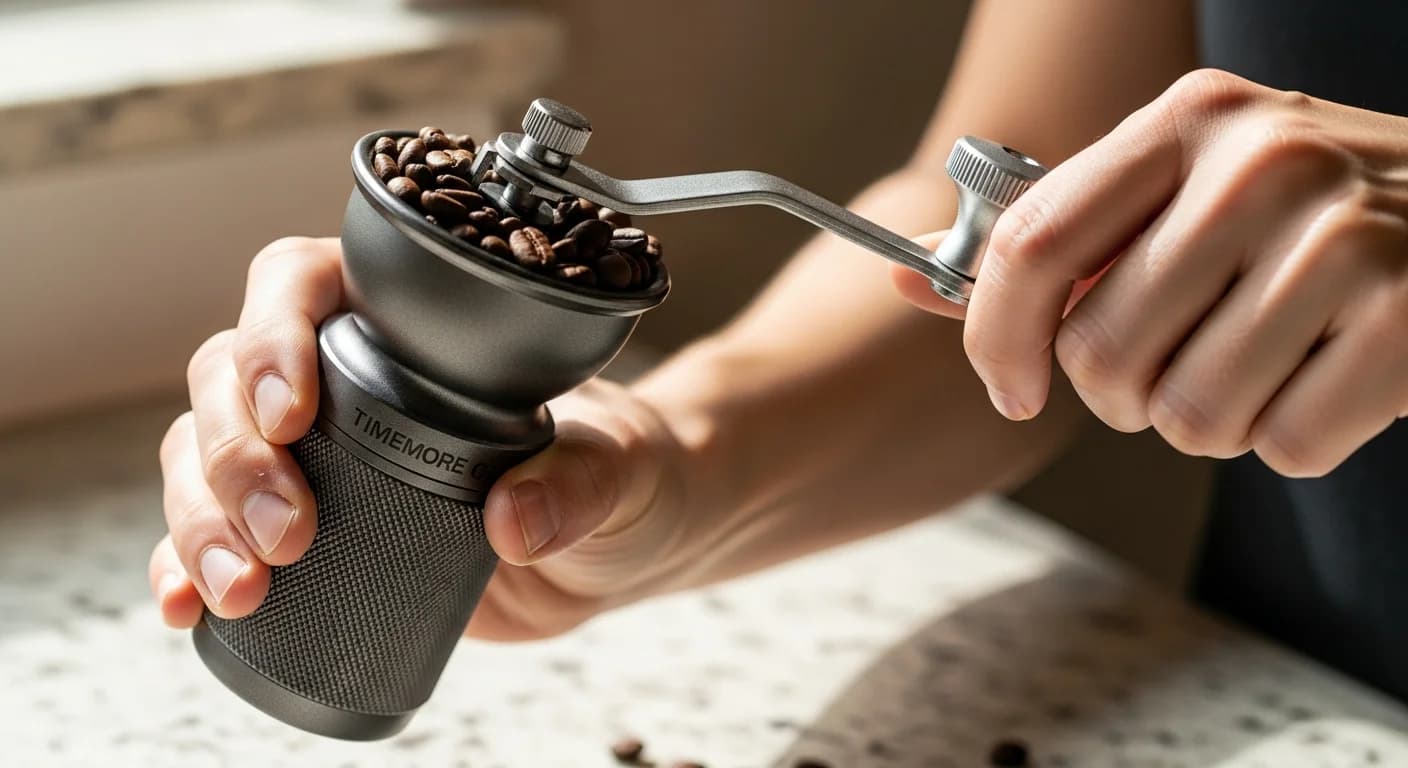
CNC-machined stainless steel burrs: Precision-machined burrs achieve tighter tolerances than ceramic, producing more uniform particle distribution and less fine powder (known as fines) in the grind. They are also more durable over years of daily use. High-quality brands like TIMEMORE use this approach. Recommended for those who want the best grind quality.
2. Grind adjustment mechanism
Different brewing methods require different grind sizes — from fine for espresso to coarse for French press. A stepped adjustment mechanism offers clear, repeatable settings that are easy to return to. A stepless mechanism allows finer adjustment but can be harder to replicate precisely. For beginners, a clearly marked stepped mechanism is the more practical choice.
3. Capacity
For a single person brewing one cup at a time, a 20–25g capacity is sufficient. For two people or for someone who prefers to grind a larger batch, look for 30–40g capacity. Larger burr sets also tend to grind faster, reducing the time and effort per session.
4. Price and intended use
For a first manual grinder, a budget of $25–$50 offers excellent value. Models in this range deliver grind quality that surpasses most electric grinders under $100. For those who want the highest performance available in a hand grinder, $60–$100 opens up options with tighter tolerances and more consistent output.
Recommended Manual Grinders: Three Ranked Picks
Rank 1: TIMEMORE C2 — Best Overall Performance and Value
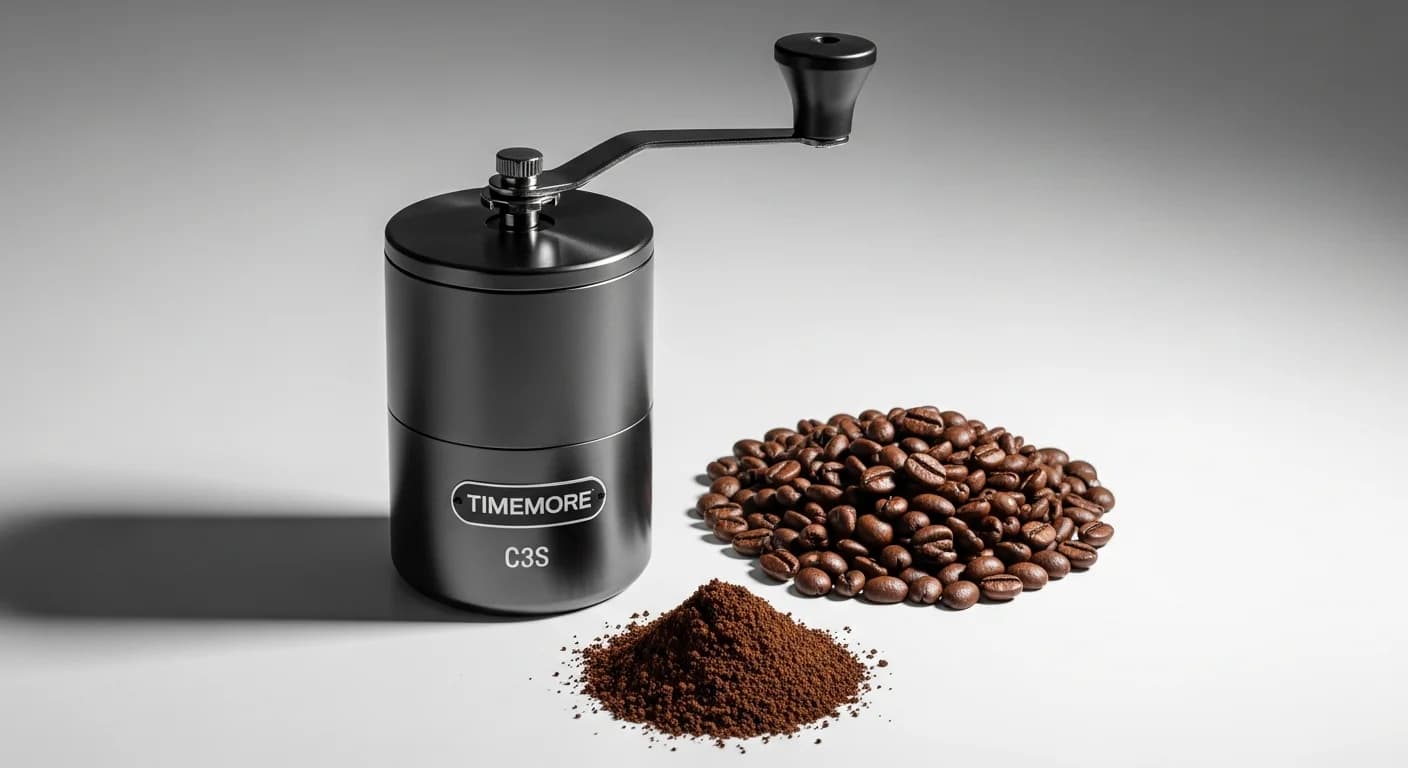
The TIMEMORE C2 consistently surprises people with how much grind quality it delivers at its price. The CNC-machined stainless steel burrs produce a remarkably uniform particle size with minimal fines — a result that noticeably benefits pour-over and filter coffee in particular. The 36-step adjustment covers the full range from fine espresso grinds to coarse French press grinds with reliable repeatability.
The aluminum body is lightweight (430g) and well-balanced in the hand, making grinding less fatiguing. Its clean, modern design also makes it a pleasure to have on the counter. The C2 is the right choice for anyone serious about fresh grinding who does not want to spend over $100 for a quality result.
Best for: Daily home brewing, V60, AeroPress, and drip coffee; anyone who wants high grind quality without investing in a premium electric grinder.
Rank 2: Porlex Mini II — Japanese Precision in the Smallest Package
Porlex is a Japanese manufacturer based in Kagoshima, and the Mini II is their most portable model. At just 13.5cm tall and 5cm in diameter, it is the most compact quality hand grinder available. The Japanese-made ceramic burrs have built an international reputation for consistent grind quality and long-term durability.
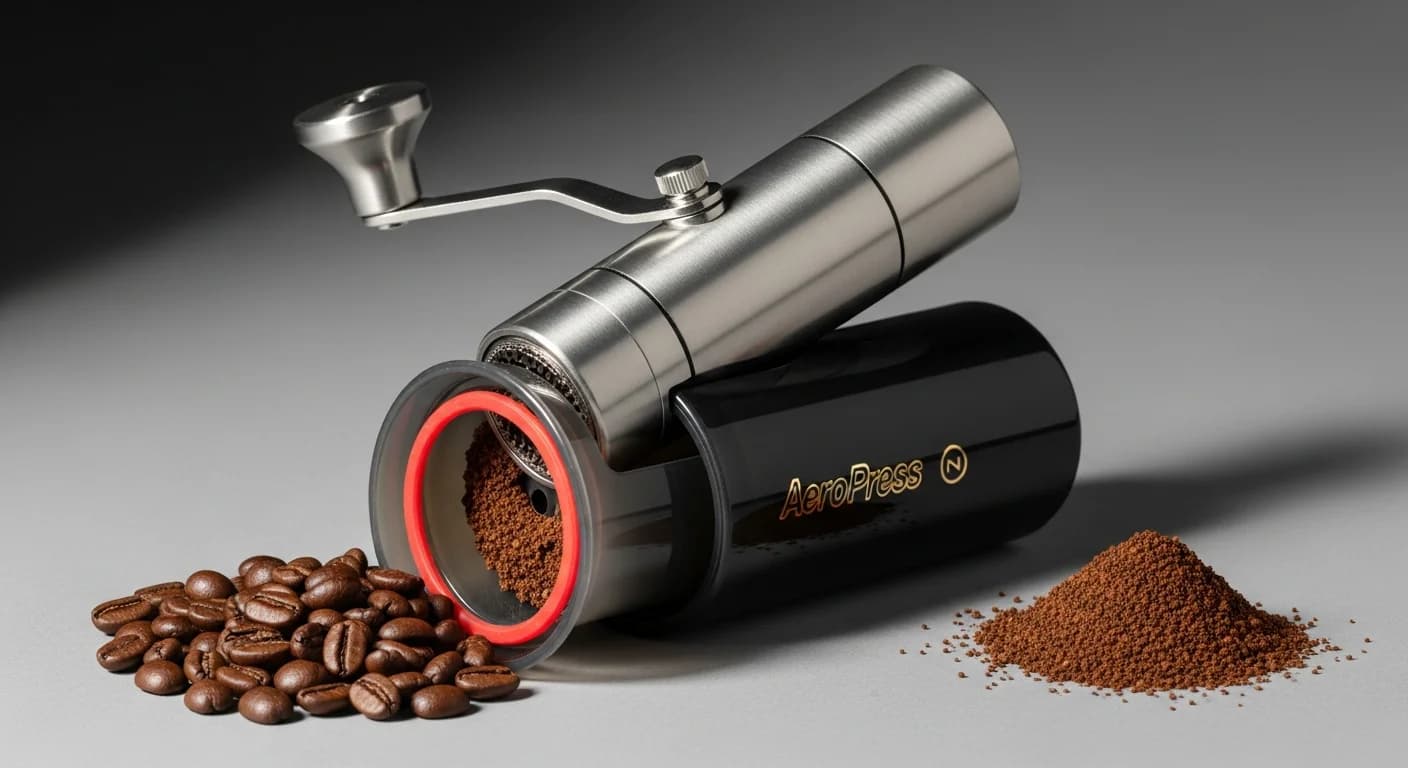
Every part of the Porlex Mini II disassembles for washing, making it one of the easiest hand grinders to keep clean. Grind size adjusts in 18 steps, from espresso to coarse. It fits inside an AeroPress chamber for storage — a feature well-known among AeroPress enthusiasts who travel.
Best for: Travel, camping, AeroPress users, and anyone with limited counter or storage space; those who prioritize washability and Japanese manufacturing quality.
Rank 3: HARIO Ceramic Slim MSS-1B — The Accessible Entry Point
HARIO is one of Japan's most respected coffee equipment brands, and the Ceramic Slim is their entry-level hand grinder. At under ¥3,000, it is the most affordable option in this comparison, and it does a credible job for drip coffee and pour-over applications.
Grind uniformity is not quite as precise as the C2 or Porlex, and very fine grinds for espresso are not within its ideal range. But for medium grinds used in V60, Chemex, or standard drip, it performs reliably. It is also an attractive gift option for someone curious about hand grinding but not yet ready to commit to a more expensive model.
Best for: True beginners trying hand grinding for the first time; budget-conscious buyers; a first gift for someone who enjoys coffee.
Comparison at a Glance
| Criteria | TIMEMORE C2 | Porlex Mini II | HARIO Slim |
|---|---|---|---|
| Price | ~¥5,990 | ¥9,130 | ¥1,927 |
| Burr material | CNC stainless | Ceramic (Japanese) | Ceramic |
| Adjustment | 36-step | 18-step | Dial |
| Capacity | ~20g | ~20g | ~24g |
| Portability | Medium | High (smallest) | Medium |
| Best for | Intermediate–advanced | Beginner–intermediate | Beginners |
Note: prices for the Porlex Mini II and HARIO Slim are from Amazon Japan (September 2026).
Unsure which to choose? If budget allows, the TIMEMORE C2 is the strongest all-around recommendation. If portability and compact size are your top priorities, the Porlex Mini II is the best option. If you simply want to try hand grinding without committing too much, start with the HARIO Slim.
Grinding Tips: How to Get the Best Results
Measuring before grinding
Always weigh your beans before grinding. A standard starting point is 10–15g per cup. Use a kitchen scale rather than a scoop measure — volumetric measurement is less consistent because bean density varies. Grind immediately before brewing and aim to complete brewing within five minutes of grinding.
Handle technique for consistent results
Turn the handle at a slow, steady pace rather than as fast as possible. Rapid turning can cause the burr shaft to wobble, increasing particle size variation. A comfortable rhythm of one full rotation per second is a good baseline. Expect 1–2 minutes to grind 15g of medium-density beans.
Grind size reference guide
- Extra fine (espresso): Powdery, like cocoa
- Fine (moka pot): Slightly finer than table sugar
- Medium-fine (V60 pour-over): Similar to granulated sugar
- Medium (general drip): Like coarse sand
- Coarse (French press): Like coarse sea salt
Cleaning and maintenance
After each use, remove the grounds container and brush out any residual coffee from the burr set. A small stiff-bristle brush is ideal. Once a week, disassemble the grinder fully and clean each part. For ceramic burrs, warm water and mild dish soap work well — just ensure everything is fully dry before reassembly. Coffee oils left on burrs can oxidize and contribute stale flavors to future brews.
Summary: Fresh Grinding Is the Best Upgrade You Can Make
A good manual grinder is one of the highest-return investments in coffee quality available at any budget. Here is what to take away:
- TIMEMORE C2: CNC stainless burrs, 36-step adjustment, the strongest all-around performer in the $40–$50 range
- Porlex Mini II: Japanese ceramic burrs, fully washable, the best option for portability and travel
- HARIO Ceramic Slim: Affordable ceramic burrs, perfect entry point for beginners
Freshly ground coffee, brewed immediately, simply tastes better — brighter, more aromatic, more expressive of the bean's origin. Any of the grinders above will give you that experience. Choose the one that fits your budget and lifestyle, and start grinding fresh.
Related Articles
- Best Coffee Grinders Under 5000 Yen: 6 Picks for Every Beginner
- Best Coffee Grinders Under 5,000 Yen: 7 Picks for Beginners
- Porlex Mini II Coffee Grinder Review: Japanese Ceramic Burrs Tested
- 10 Coffee Gear Picks for 2026: The Best New and Notable Home Brewing Equipment
- Best Automatic Milk Frothers Ranked: 7 Picks for Cappuccinos and Lattes at Home
About the AuthorExpert Reviewed

Coffee Guide Editorial
A team of certified writers and baristas with hands-on experience at origin farms and roasteries. We deliver practical, experience-backed guides on bean selection, brewing methods, and equipment reviews.
Credentials & Experience
- J.C.Q.A. Certified Coffee Instructor
- SCA Certified Barista
- 5+ years running a specialty roasting café
- 200+ coffee beans tasted annually