World Coffee Culture Guide — Ethiopia, Italy, Japan, Nordic Countries, and Turkey
PRThis article contains affiliate links
Key Takeaways
- Ethiopia's coffee ceremony is one of the world's oldest coffee rituals, serving three rounds with symbolic meaning
- In Italy, espresso at the bar is a daily rhythm — not a luxury experience but a way of life
- Nordic fika culture, Japan's kissaten, and Turkish cezve each embody distinct philosophies around the act of drinking coffee
Coffee is the world's second most traded commodity, but the way people drink it could not be more different from one country to the next. Italians throw back a tiny cup of espresso in ninety seconds and get on with their day. Ethiopians spend two hours on a ceremony that transforms the same beverage into a sacred act of hospitality. Japanese kissaten regulars expect their barista to remember exactly how they like their hand-drip.
This guide takes you through five distinct coffee cultures — their origins, rituals, and what they reveal about the societies that shaped them. Whether you are planning a trip abroad or simply curious about what coffee means to people around the world, read on.
Ethiopia: The Birthplace of Coffee and Its Most Elaborate Ritual
Where Coffee Began
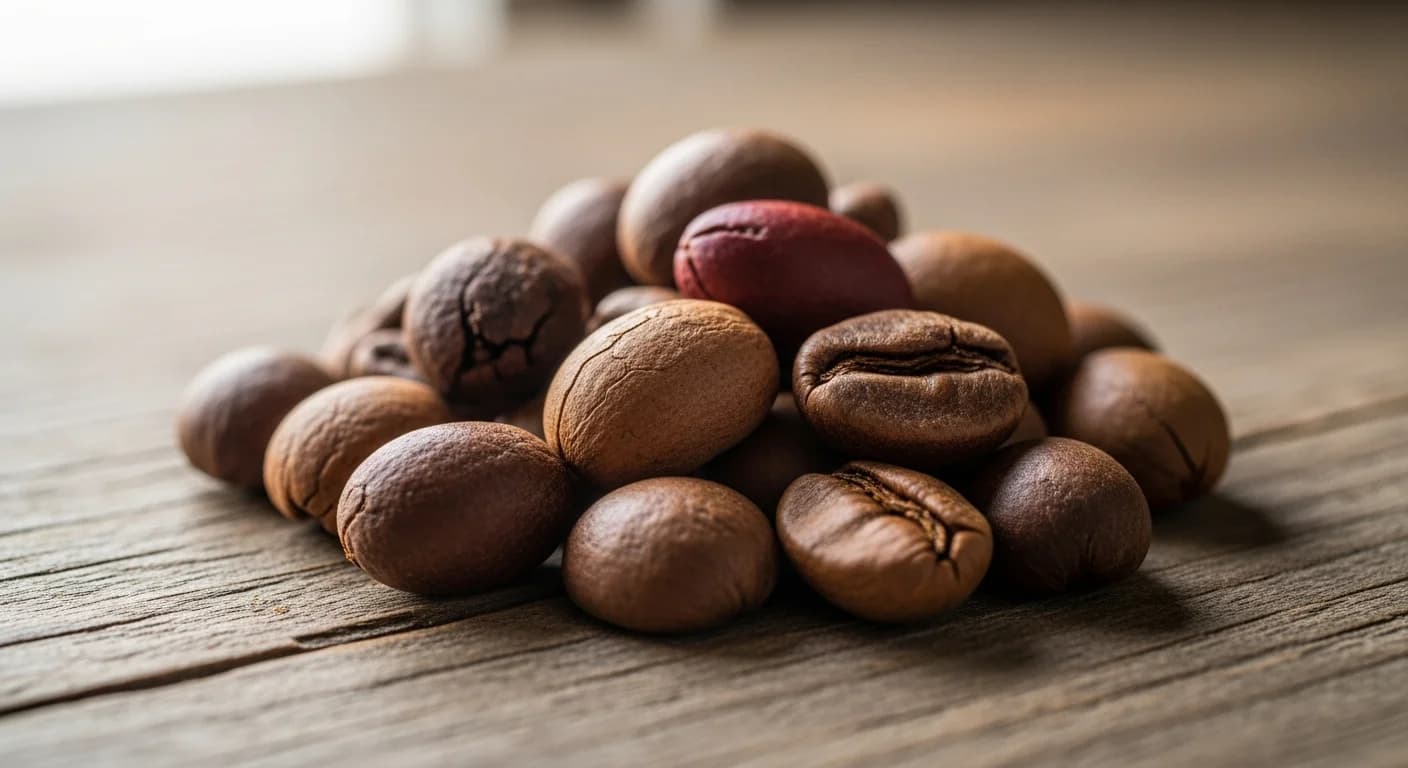
Ethiopia is widely accepted as the geographic origin of coffee. The most famous origin story involves a goatherd named Kaldi who, around the 9th century, noticed his goats becoming unusually energetic after eating the red berries of a certain shrub in the Kaffa region of southwestern Ethiopia. The name "coffee" itself is thought to derive from "Kaffa," the region where wild coffee trees have grown for millennia.
Today, Ethiopia remains one of the world's top coffee producers, and coffee is deeply woven into the fabric of daily and ceremonial life.
The Coffee Ceremony: Three Rounds of Blessing
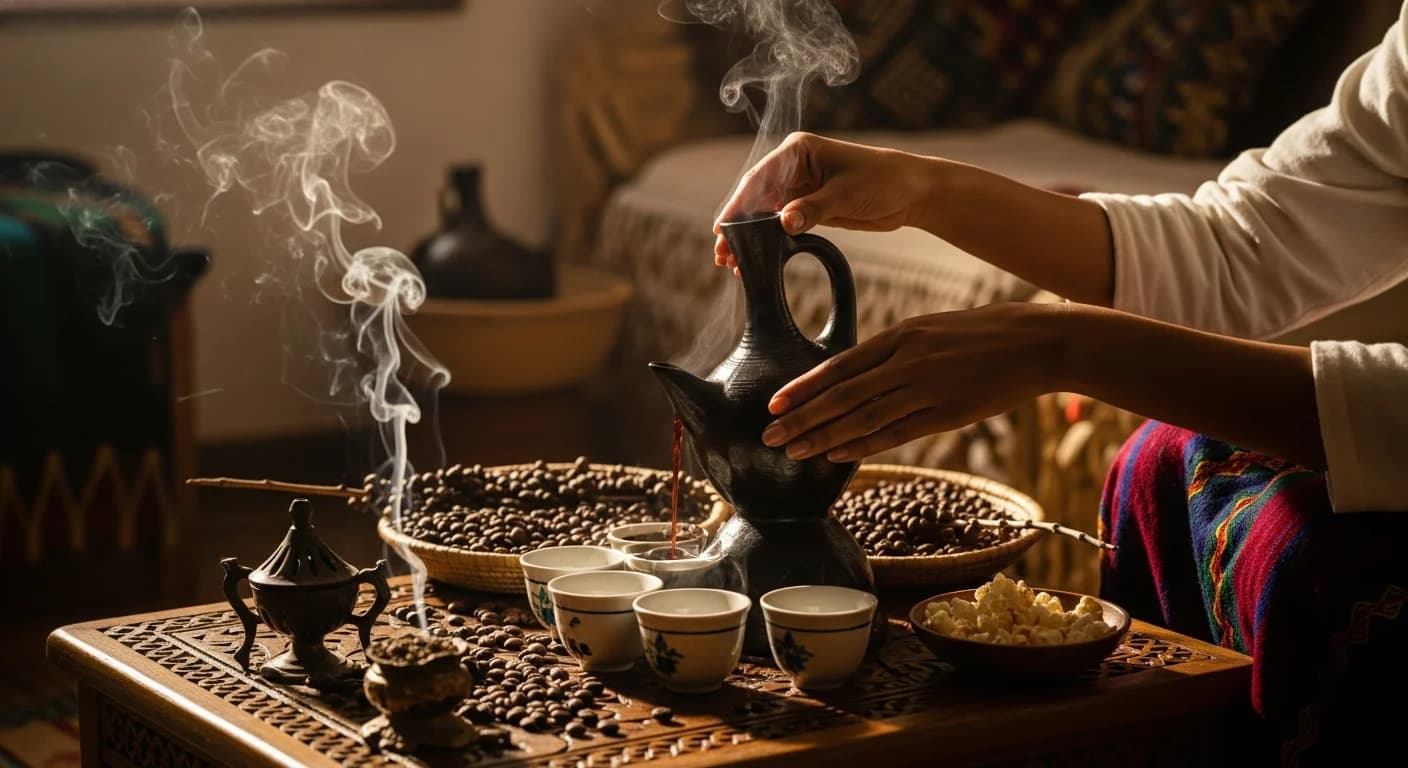
The Ethiopian coffee ceremony — known as Buna Tirttu — is considered one of the world's most elaborate and meaningful coffee rituals. It is performed to welcome guests, mark special occasions, and strengthen community bonds. A full ceremony takes one to two hours and follows a specific sequence.
The Ceremony, Step by Step
- Green coffee beans are roasted over an open flame in an iron pan, filling the room with fresh roasting aroma — guests lean in to breathe the scent as a sign of appreciation
- The roasted beans are ground by hand using a mortar and pestle
- Ground coffee is brewed in a jebena — a round-bottomed clay pot with a long neck — over hot coals
- Coffee is poured into small handle-less cups (sini) and served with sugar
- The ceremony consists of three rounds: Abol (first), Tona (second), and Baraka (third)
- The final round, Baraka, means "blessing" — completing all three rounds brings good fortune
Coffee is typically served alongside popcorn (called foll) or roasted grain. The ceremony is not merely about drinking coffee — it is a structured occasion for conversation, community, and the expression of hospitality. In 2024, the Ethiopian coffee ceremony was inscribed on UNESCO's Representative List of the Intangible Cultural Heritage of Humanity.
Italy: Espresso Is Not a Drink — It Is a Rhythm
The Bar as Social Institution
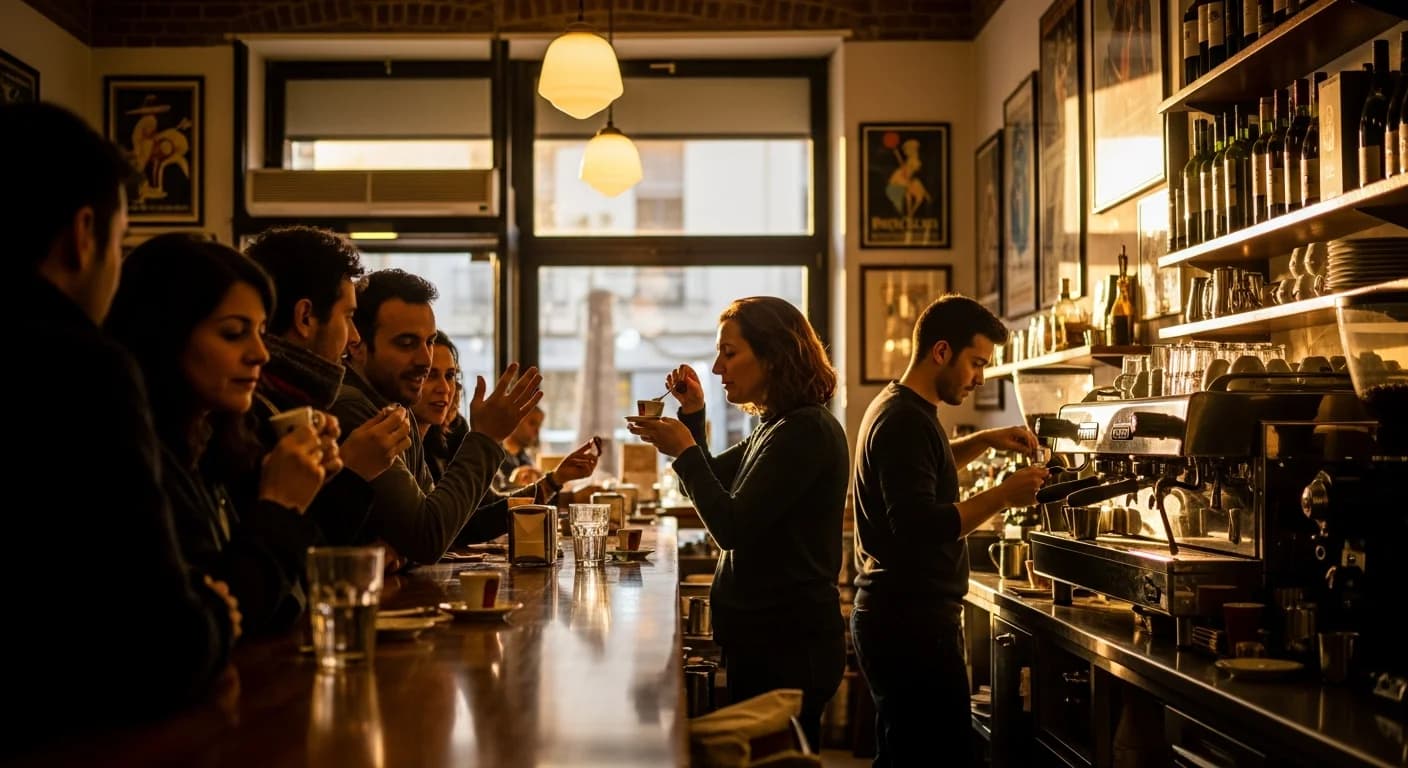
In Italy, the center of coffee culture is not a café with plush seats and laptop-friendly tables. It is the bar — a standing counter where you order, drink, and leave within two minutes. Sitting at a table is possible but typically comes at a higher price; the Italian bar experience is fundamentally about efficiency and sociability in motion.
The bar is a neighborhood institution. Most Italians have a regular bar they visit every morning, where the barista knows their order and a few words of exchange are as much a part of the ritual as the coffee itself.
The Unwritten Rules
Italian espresso culture has a set of informal conventions that can surprise visitors.
- Cappuccino is for mornings only: Milky coffee drinks are breakfast fare. Ordering a cappuccino after 11am is considered a tourist move by many Italians
- Espresso is consumed in seconds: A standard Italian espresso is approximately 25–30ml. It is sipped — or sometimes drunk in one or two mouthfuls — ideally within a minute or two of being served
- Sugar is standard: Many Italians stir a spoonful of sugar into their espresso, mix it thoroughly, and drink from the bottom up where the sweetness concentrates
How to Order Like a Local
Ask for un caffè, per favore and you will receive a standard espresso (normale). For a slightly shorter, more concentrated shot, ask for un ristretto. For a longer, more diluted version, request un lungo. At breakfast, un cappuccino e un cornetto (a cappuccino and a croissant) is the classic combination.
In 2019, the art of Italian espresso coffee was added to UNESCO's Intangible Cultural Heritage list — making Italy's approach to coffee one of only a handful of beverage traditions ever to receive this international recognition.
Japan: Kissaten and the Art of Careful Attention
A History of Coffee Houses
Japan's coffee culture is rooted in the kissaten (喫茶店) — the traditional Japanese coffee house. The first is generally considered to be Kahiichakan, which opened in Ueno, Tokyo in 1888, drawing inspiration from European café culture. Through the Meiji, Taisho, and Showa eras, kissaten became gathering places for intellectuals, office workers, and students — sanctuaries of quiet in increasingly busy cities.
What Makes Japanese Coffee Culture Distinct
Japanese coffee culture is defined by two qualities above all: quietness and craft.
- Nel drip (flannel filter drip): Dripping coffee through a cloth (flannel) filter rather than paper produces a softer, rounder cup with less papery bitterness. Nel drip is particularly associated with old-school kissaten and is rarely found outside Japan
- Siphon coffee: The glass siphon brewer — which uses vapor pressure to push water through coffee grounds — was popular in mid-20th century Japan and remains a signature kissaten method
- Morning service (Nagoya style): In the Nagoya region, many kissaten offer a complimentary piece of toast and a boiled egg with every cup of coffee ordered before 11am — a tradition called morning service that has no parallel elsewhere in the world
Third Wave Meets Kissaten
In recent years, a new generation of Japanese coffee shops has emerged that blends the quiet, intentional atmosphere of the kissaten with the single-origin, specialty coffee philosophy of the third wave. Roasters like Maruyama Coffee and cafes like Fuglen Tokyo draw both coffee tourists and local enthusiasts who want the craft of specialty coffee without sacrificing the contemplative mood of traditional Japanese coffee culture.
Hospitality Through Precision
Japanese coffee culture is inseparable from the concept of omotenashi — the spirit of selfless hospitality. A skilled kissaten barista might spend five minutes preparing a single pour-over, measuring each variable carefully and adjusting to the individual cup. The act of making coffee for someone is treated as a form of care, not a transaction.
Nordic Countries: Fika, Light Roasts, and the World's Biggest Coffee Drinkers
Why the North Drinks So Much Coffee
The Nordic countries — Finland, Sweden, Norway, Denmark — are among the world's highest per-capita coffee consumers. Finland consistently ranks first or second globally, with annual consumption approaching 12kg of coffee per person. Norway and Sweden are close behind.
The cold, dark winters and long summer days of the region are often cited as cultural factors in coffee's dominance: the beverage has served for centuries as a source of warmth, energy, and social connection in isolated communities.
Fika: More Than a Coffee Break
The most internationally recognized element of Nordic coffee culture is fika — a Swedish concept that resists simple translation. Fika is not merely a coffee break. It is an intentional pause in the day, typically involving coffee (or tea) and something sweet, taken in good company.
What Fika Actually Is
Fika typically involves kanelbullar (cinnamon buns) or other pastries alongside coffee. What distinguishes it from an ordinary break is its social and philosophical intent: fika is time explicitly set aside for human connection, away from work demands. Many Swedish workplaces schedule fika twice a day as a formal practice — a tradition that researchers have noted contributes positively to workplace wellbeing and team cohesion.
The Nordic Love of Light Roasts
Nordic coffee culture also has a distinctive relationship with roast level. Long before the third wave popularized light roasting globally, Scandinavian roasters were applying lighter profiles to preserve the natural character of the bean. This preference for clean, bright, and nuanced coffee — rather than the dark, bitter espresso styles dominant in southern Europe — has made Nordic countries natural allies of the specialty coffee movement.
Turkey: A Five-Century Tradition and the Art of Reading the Grounds
The Cezve and Its Method
Turkish coffee culture has been practiced for over five hundred years. Its defining tool is the cezve (pronounced "jezve") — a small, long-handled pot traditionally made of copper or brass. Extra-finely ground coffee is combined with cold water (and sugar, if desired) in the cezve and heated very slowly over low flame, stirred gently until it froths and rises.
Turkish Coffee: Key Characteristics
- Coffee is ground finer than for espresso — almost to a powder
- It is not filtered; grounds settle in the cup and are left undisturbed
- Sugar is specified at the time of ordering: sade (none), az şekerli (a little), orta (medium), çok şekerli (sweet)
- After drinking, the cup is inverted onto the saucer and allowed to cool; the patterns formed by the settled grounds are read as omens in the tradition of tasseography (coffee ground reading), called fal in Turkish
UNESCO Recognition and Social Meaning
In 2013, Turkish coffee culture and tradition was inscribed on UNESCO's Intangible Cultural Heritage list. The inscription recognizes coffee's role in Turkish society as a vehicle for hospitality, friendship, and elegance. A Turkish proverb captures the depth of this tradition: "The memory of a cup of coffee lasts forty years." Refusing a cup of coffee offered by a host is considered impolite; accepting it affirms the bond of friendship.
Comparing the Five Coffee Cultures
| Culture | Style | Key Characteristic | Cultural Meaning |
|---|---|---|---|
| Ethiopia | Coffee ceremony | Three-round ritual from green bean | Blessing, community, hospitality |
| Italy | Espresso at the bar | Fast, social, standing | Daily rhythm, neighborhood identity |
| Japan | Kissaten, pour-over | Quiet precision, craft | Omotenashi, mindfulness |
| Nordic | Fika, light roast | Intentional pause with others | Wellbeing, social connection |
| Turkey | Cezve coffee | Unfiltered, grounds-reading | Friendship, tradition, fortune |
Summary
Coffee reveals something essential about the cultures it lives in. In Ethiopia, it is a sacred ritual of blessing and community. In Italy, it is the efficient lubricant of daily social life. In Japan, it is an expression of careful attention and hospitality. In the Nordic countries, it is a built-in space for human connection in a demanding world. In Turkey, it is a five-century tradition that binds friendships and reads the future.
The next time you order a cup of coffee — wherever you are in the world — consider what that cup might mean in another context. You might find that coffee, for all its apparent simplicity, carries the weight of civilization in every sip.
Related Articles
- Complete History of Coffee — From Ethiopian Origins to Modern Specialty
- Ethiopian Coffee Ceremony — Traditional Ritual in the Birthplace of Coffee
- Italian Espresso Culture — Bar Culture and Drinking Etiquette
- What Is Third Wave Coffee? A Complete Guide to the History and Meaning of Coffee's Three Waves
- How to Open a Coffee Café in Japan — Licenses, Costs, and Steps
Frequently Asked Questions
QHow does coffee culture vary around the world?
QWhich country drinks the most coffee per capita?
QWhere did coffee originate?
About the AuthorExpert Reviewed

Coffee Guide Editorial
A team of certified writers and baristas with hands-on experience at origin farms and roasteries. We deliver practical, experience-backed guides on bean selection, brewing methods, and equipment reviews.
Credentials & Experience
- J.C.Q.A. Certified Coffee Instructor
- SCA Certified Barista
- 5+ years running a specialty roasting café
- 200+ coffee beans tasted annually