Coffee Flavor Wheel Guide: How to Taste and Describe Coffee Like a Pro
PRThis article contains affiliate links
Key Takeaways
- The SCA Coffee Taster's Flavor Wheel is organized in concentric rings from 9 broad categories at the center to specific flavor descriptors at the outer edge — you taste from center outward
- Professional coffee evaluation covers five dimensions: aroma, flavor, aftertaste, acidity, and body — learning to distinguish these transforms how you experience coffee
- Regular cupping practice combined with deliberate attention to food flavors in daily life is the most effective way to develop a precise coffee vocabulary
"It's good." "It's strong." "It tastes like coffee." Most people's coffee vocabulary stops here. But professional coffee tasters — Q-graders, barista competitors, and specialty roasters — describe the same cup in terms of jasmine, blackcurrant, brown sugar, and the finish of dark chocolate. The gap between these descriptions isn't about a superhuman palate. It's about a framework and practice.
That framework is the SCA Coffee Taster's Flavor Wheel.
What Is the Coffee Flavor Wheel?
The Coffee Taster's Flavor Wheel was developed jointly by the SCA (Specialty Coffee Association) and World Coffee Research (WCR), with the current version released in 2016. It is the global standard for coffee flavor description — used by baristas, roasters, buyers, and competition judges worldwide.
According to the SCA's published research, the Flavor Wheel grew out of WCR's Sensory Lexicon, which established standardized reference samples for each flavor descriptor. This means "blueberry" in the wheel isn't subjective — it corresponds to a specific commercial blueberry reference product that all trained tasters use as a calibration point.
Structure of the Flavor Wheel
The wheel is arranged in three concentric rings:
- Innermost ring: 9 major flavor categories
- Middle ring: Sub-categories within each major group
- Outer ring: Specific, precise flavor descriptors
The 9 Major Categories
- Fruity — All fruit-derived flavors
- Sour/Fermented — Fermentation-derived acidity and complexity
- Green/Vegetative — Grass, raw bean, vegetable notes
- Other — Paper, musty, chemical, smoky
- Roasted — Tobacco, burnt, acrid (typically negative)
- Spices — Anise, pepper, clove, nutmeg
- Nutty/Cocoa — Almonds, hazelnuts, chocolate, cocoa
- Sweet — Vanilla, caramel, overall sweetness perception
- Floral — Rose, jasmine, chamomile, honeysuckle
According to Perfect Daily Grind's analysis of the Flavor Wheel's methodology, the color coding on the wheel is intentional: warm colors (oranges, reds) indicate positive flavor descriptors, while cooler grays and blues at the "Other" and "Roasted" extremes often indicate defects or undesirable notes. Using color as a first guide helps beginners quickly identify whether a flavor they're describing is generally positive.
The Five Tasting Dimensions
Professional coffee evaluation uses five dimensions beyond simple "flavor":
1. Aroma
Evaluated before tasting, by smelling the dry grounds and then the wet grounds just after brewing. Aroma is often where the most distinctive notes — floral, fruit, spice — are most clearly perceived because volatiles escape most freely at this stage.
2. Flavor
The total sensory impression when the coffee is in your mouth — the integration of taste (from tongue) and retronasal aroma (from the back of the throat). This is what most people mean when they say "how does it taste."
3. Aftertaste
What remains after swallowing. Long, sweet aftertastes are positive quality indicators. Short, harsh, or bitter aftertastes can indicate over-extraction, dark roast dominance, or low-quality beans.
4. Acidity
Not the pH measurement but the sensory quality and intensity of bright, clean acids. "Bright acidity" is a positive descriptor for the clean tartness of a well-grown Ethiopian washed coffee. "Flat acidity" or "harsh acidity" indicates either oxidation or processing defects.
5. Body
The physical weight and texture of the coffee in the mouth. French Press-brewed dark roast has "heavy body." Chemex-filtered light roast has "light, clean body." Neither is better — they're appropriate for different preferences and contexts.
Using the Flavor Wheel in Practice
Step 1: Start with the Major Category
Is the dominant character:
- Bright and refreshing? → Fruity or Floral direction
- Rich and warm? → Nutty/Cocoa or Sweet direction
- Complex and developed? → Roasted or Spices
Don't try to name a specific flavor immediately. Start with the hemisphere.
Step 2: Move to Sub-Category
Within Fruity: Is it Citrus (sharp, clean) or Berry (round, dark) or Tropical (exotic, dense)?
Step 3: Name the Specific Descriptor
"Berry → Strawberry" or "Citrus → Lemon" or "Tropical → Mango"
You don't need to arrive at a specific descriptor every time. "I'm getting berry, maybe strawberry-ish" is legitimate tasting language.
Keep the Flavor Wheel printed or on your phone while tasting. Spend 5 minutes with each cup you drink doing this practice: identify the major category first, then narrow. After 30–40 cups with deliberate attention, you'll find your vocabulary expanding naturally without needing to consult the wheel.
Home Cupping Basics
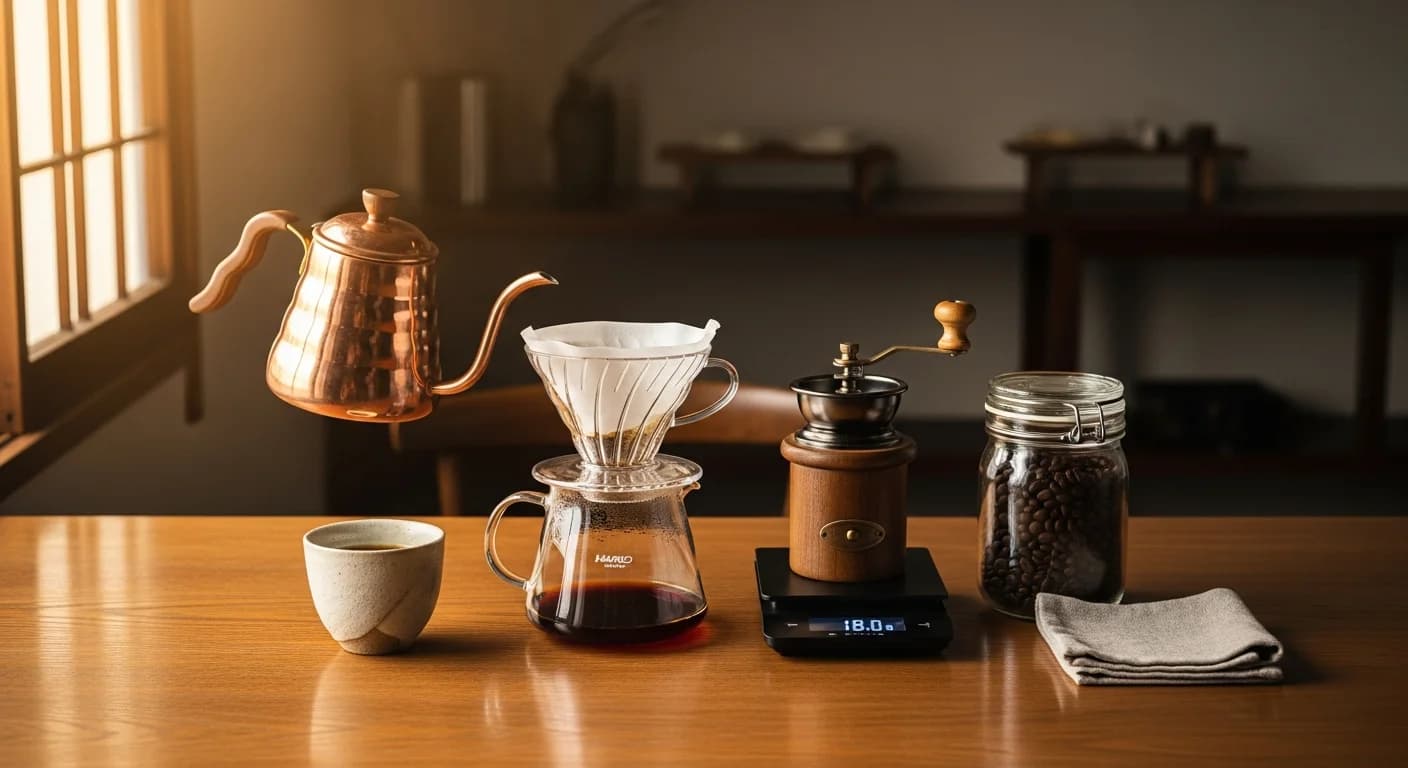
Cupping (the professional tasting protocol) can be practiced at home with minimal equipment:
- Grind coarsely — 8.25g of coffee
- Place in a cup (any cup or bowl works)
- Add 150ml of 93°C water
- Wait 4 minutes (a "crust" of grounds will form on top)
- Break the crust with a spoon, pushing the grounds gently to the side — smell this moment intensely
- Wait for the cup to cool to 70°C, then use a spoon to slurp loudly
- Loud slurping sprays coffee across all taste receptors and introduces air, enhancing flavor perception
- Taste again at 50°C — different flavors emerge at different temperatures
Regional Flavor Reference Guide
Understanding the typical flavor profile of each major origin helps you use the Flavor Wheel more efficiently:
| Origin | Dominant Wheel Category | Typical Descriptors |
|---|---|---|
| Ethiopia (Yirgacheffe) | Fruity > Berry + Floral | Strawberry, jasmine, lemon |
| Kenya | Fruity > Berry | Blackcurrant, tomato, grapefruit |
| Colombia | Sweet + Fruity > Citrus | Caramel, apple, milk chocolate |
| Brazil | Nutty/Cocoa | Almond, chocolate, peanut |
| Indonesia (Mandheling) | Other > Earthy | Earth, cedar, dark chocolate |
| Panama (Geisha) | Floral + Fruity | Jasmine, bergamot, peach |
| Guatemala (Antigua) | Nutty/Cocoa + Sweet | Chocolate, caramel, smoky |
Building Your Palate Beyond Coffee
Tasting practice is most effective when it extends beyond coffee:
- Eat fruit slowly: What kind of fruit? Which part of the flavor wheel?
- Smell herbs and spices: Cardamom, cinnamon, anise, black pepper — know what they smell like
- Try dark chocolate varieties: 70%, 85%, 99% cacao — learn the spectrum of chocolate notes
- Drink specialty tea: Learn what "jasmine," "bergamot," and "black tea" actually smell and taste like before finding them in coffee
These practices build the mental reference library that turns the Flavor Wheel from a theoretical tool into an accurate description of what you actually perceive.
Summary
The SCA Coffee Flavor Wheel is the world's standard framework for coffee description — and a genuinely useful tool for any coffee drinker who wants to understand their preferences more precisely.
Key takeaways:
- The Flavor Wheel organizes 9 major categories into increasingly specific descriptors — taste from center outward
- Five evaluation dimensions (aroma, flavor, aftertaste, acidity, body) give a complete picture beyond "taste"
- Home cupping requires only coffee, hot water, a cup, and a spoon — start at 4 minutes steep + slurping
- Building your reference library through fruit, spice, chocolate, and tea tasting accelerates flavor vocabulary development
Related Articles
- Anaerobic Fermentation Coffee: What It Is & Why It Tastes So Different
- Costa Rica Coffee Beans: Honey Process, Tarrazu & Flavor Guide
- Geisha Coffee: Why It Costs So Much & What Makes It Extraordinary
- Guatemala Coffee Beans: Antigua, Huehuetenango & Flavor Guide
- Jamaica Blue Mountain Coffee: Why It Costs So Much & Is It Worth It?
About the AuthorExpert Reviewed

Coffee Guide Editorial
A team of certified writers and baristas with hands-on experience at origin farms and roasteries. We deliver practical, experience-backed guides on bean selection, brewing methods, and equipment reviews.
Credentials & Experience
- J.C.Q.A. Certified Coffee Instructor
- SCA Certified Barista
- 5+ years running a specialty roasting café
- 200+ coffee beans tasted annually