Ethiopian Coffee Ceremony — Traditional Ritual in the Birthplace of Coffee
PRThis article contains affiliate links
Key Takeaways
- The Ethiopian coffee ceremony begins with roasting green beans and takes one to two hours from start to finish
- Three rounds of coffee are served, each with distinct cultural meaning — transformation, blessing, and long life
- The ceremony is not simply drinking coffee but a social ritual expressing hospitality, community, and respect
In the country where coffee originated, drinking it has never been a simple act. Ethiopia's coffee ceremony — called Buna Maflat in Amharic, meaning "the preparation of coffee" — is a ritual that lasts one to two hours, involves roasting green beans over charcoal, and centers on three successive rounds of coffee with distinct cultural meanings. It is one of the world's most distinctive expressions of what coffee means to a society.
Ethiopia and Coffee: An Ancient Relationship
Ethiopia is the genetic homeland of Coffea arabica. Wild coffee plants still grow in the highland forests of Kaffa and Bale, where the beverage's history runs at least a thousand years. The now-legendary story of the goatherd Kaldi, whose animals became unusually energetic after eating coffee berries, is associated with these Ethiopian highlands.
Coffee is not merely a beverage here — it is central to social life, to national identity, and to the livelihoods of millions of farming families.
Ethiopia's Coffee Regions
Ethiopia produces some of the world's most celebrated coffees, all grown from ancient heirloom varieties:
- Yirgacheffe: Floral, fruit-forward, with jasmine and citrus notes — one of the world's most sought-after origins
- Sidamo: Complex, balanced, with good body
- Harrar: Dry-processed with wine-like, berry-rich flavor
These coffees are often shade-grown in garden and forest environments that have barely changed for centuries.
What the Coffee Ceremony Is
The ceremony is a daily social event in Ethiopian homes, offices, and community gatherings. It is typically performed by women — the host, wife, or eldest female present — and signals welcome and respect for guests. An invitation to participate is an honor; declining is considered impolite.
The ceremony functions as a community meeting, a problem-solving forum, a space for storytelling and intergenerational knowledge transfer, and simply a moment of shared pleasure.
The Steps of the Ceremony
Ethiopian Coffee Ceremony Flow
Setting the Space
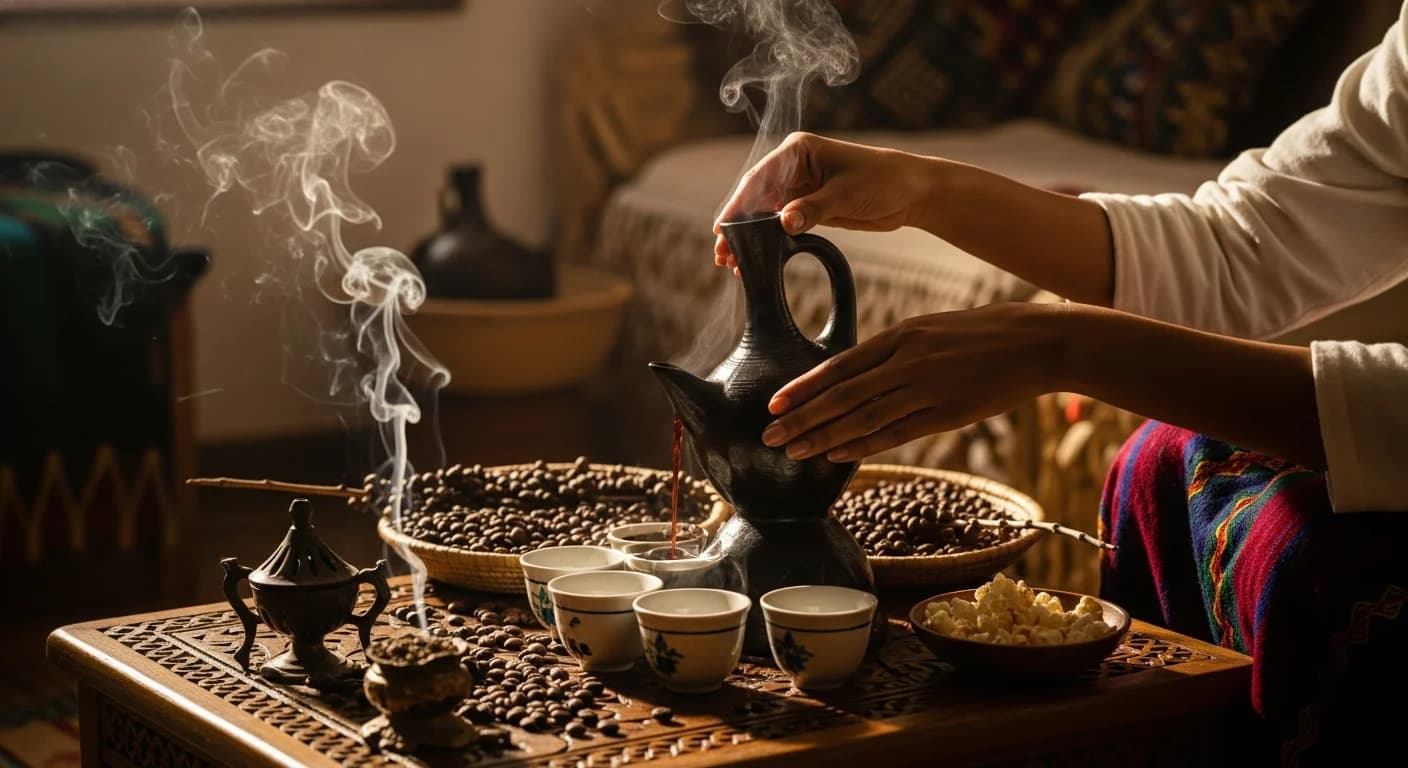
Before the ceremony begins, fresh grass or leaves (enset) may be spread on the floor, and incense — typically frankincense (lubân) — is burned to purify the space and signal that something meaningful is about to happen.
A low table or tray holds small handle-less cups (finjal), sugar, and sometimes salt or butter (regional variations).
Step 1: Roasting the Green Beans
The ceremony's most theatrical and memorable element is the hand-roasting of raw green coffee beans.
- Washing: The host washes the raw beans in water
- Roasting over charcoal: Beans go into a flat iron pan (mitad) and are stirred continuously over charcoal
- Sharing the aroma: As the beans darken and smoke rises, the host carries the roasting pan around to each guest, fanning the aromatic smoke toward them — a gesture of generosity and inclusion
- Grinding: Roasted beans are pounded in a wooden mortar (mukecha) with a pestle (zenezena) to a rough grind
Step 2: Brewing
The ground coffee goes into a traditional black clay pot with a spherical base and narrow neck, called a jebena. Water is added and the pot is placed over the coals until the coffee boils. The pot is removed, rested briefly for grounds to settle, and then the coffee is poured through a grass-bundle filter into the finjal cups.
Step 3: Three Rounds
The defining ritual structure of the ceremony is serving three consecutive rounds of coffee from the same grounds.
| Round | Name | Meaning |
|---|---|---|
| First | Abol | Strongest; signifies transformation |
| Second | Tona (Huletegna) | Slightly weaker; signifies blessing |
| Third | Bereka | Weakest; signifies long life and descendants |
The Third Cup
Ethiopian tradition holds that the third cup, bereka, carries a special divine blessing for long life and fertility. Leaving before the third cup is considered rude. The ceremony is designed to be experienced in its entirety — rushing is antithetical to its purpose.
Drinking
Coffee is typically served with sugar. Some regions add salt or butter — particularly among Oromo communities. Milk is uncommon. The coffee is accompanied by snacks: popcorn, a slightly sweet bread (dabo), or roasted barley or chickpeas.
Social Functions of the Ceremony
Community bond: The ceremony is a regular gathering point for neighbors, extended family, and colleagues to share news, concerns, and celebrations.
Conflict resolution: Community disputes are sometimes addressed and resolved in the context of a ceremony, where the ritual slows conversation and creates a more receptive atmosphere.
Intergenerational transmission: Young people observe and participate in ceremonies alongside elders, absorbing culture, values, and practical knowledge in an informal but consistent way.
Summary
The Ethiopian coffee ceremony is one of the world's most complete expressions of what coffee can be — not just a beverage but a social architecture.
- Green bean roasting, communal aroma-sharing, and hand-grinding are central to the experience
- Three rounds of coffee represent transformation, blessing, and long life
- The ceremony expresses hospitality, respect, and community in a form that has survived for centuries
The next time you drink a cup of Ethiopian coffee — that Yirgacheffe with its jasmine notes, or that Harrar with its wine-like depth — it carries the weight of this ceremony behind it. That is part of what makes it worth slowing down for.
Related Articles
- Complete History of Coffee — From Ethiopian Origins to Modern Specialty
- Italian Espresso Culture — Bar Culture and Drinking Etiquette
- World Coffee Culture Guide — Ethiopia, Italy, Japan, Nordic Countries, and Turkey
- Australian Coffee Culture — The Flat White and Melbourne's World-Class Café Scene
- Barista World Championships — WBC, WLAC, WBrC and Japanese Competitors
About the AuthorExpert Reviewed

Coffee Guide Editorial
A team of certified writers and baristas with hands-on experience at origin farms and roasteries. We deliver practical, experience-backed guides on bean selection, brewing methods, and equipment reviews.
Credentials & Experience
- J.C.Q.A. Certified Coffee Instructor
- SCA Certified Barista
- 5+ years running a specialty roasting café
- 200+ coffee beans tasted annually