Flat Burr vs Conical Burr Grinder — What's the Difference?
PRThis article contains affiliate links
Key Takeaways
- Flat burrs produce more uniform, unimodal grinds with sharper flavor separation — preferred for espresso
- Conical burrs run slower with less heat, lower retention, and broad brewing range — better for general use
- For beginners and pour-over brewers, start with conical; for dedicated espresso, upgrade to flat
Every burr grinder choice comes down to one fundamental question: flat burr or conical burr? Both grind coffee, but the geometry of the burrs affects grind distribution, flavor profile, heat generation, and retention in ways that matter — especially at the specialty coffee level.
This comparison cuts through the noise and explains what actually changes between the two types.
What this comparison covers
- How flat and conical burr geometry differs
- Grind uniformity, retention, and heat generation
- Flavor differences in the cup
- Which type suits espresso vs pour-over brewing
Flat Burr Characteristics
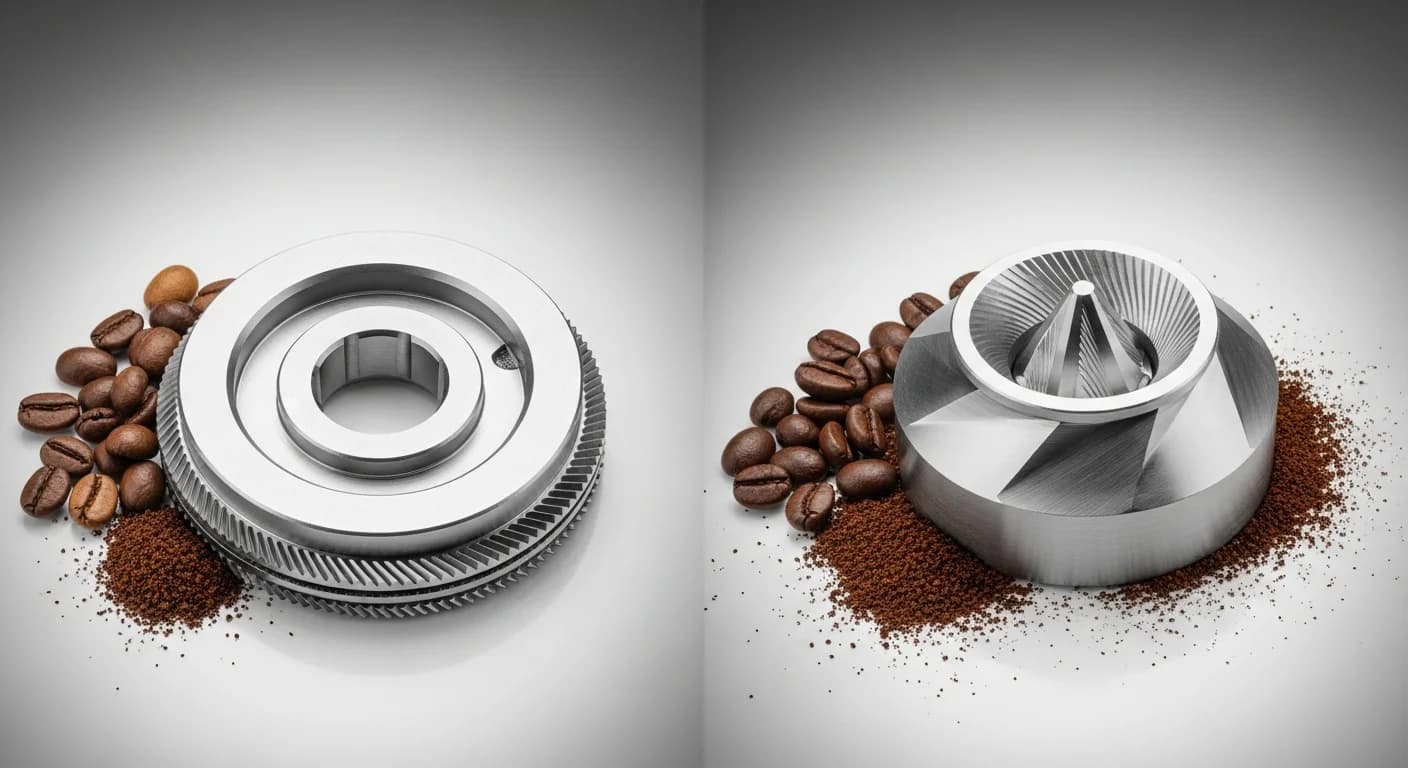
Flat burrs consist of two opposing flat disc burrs that rotate against each other. Coffee beans enter from the center and are sheared as they move outward across the burr faces.
Key characteristics:
- High grind uniformity: The shearing action produces a narrow, unimodal particle distribution
- Sharp flavor separation: Uniform particle size allows extraction compounds to dissolve at consistent rates, producing clear distinction between acidity, sweetness, and bitterness
- More heat: Flat burrs typically run at higher RPM (~1,200+), generating more frictional heat
- Higher retention: Ground coffee tends to accumulate between the burr faces
Notable flat burr grinders:
- Fellow Ode Gen 2 (accessible electric flat burr)
- Niche Zero (premium single-dose electric)
- Eureka Mignon series
Conical Burr Characteristics
Conical burrs consist of an outer ring burr and an inner cone-shaped burr. Beans are crushed and sheared as they pass between the angled faces from top to bottom.
Key characteristics:
- Lower RPM, less heat: Most conical burrs operate at 300–900 RPM, preserving volatile aromatic compounds
- Lower retention: Gravity assists coffee movement through conical geometry — less ground coffee remains in the burr chamber
- Broader grind range: Handles fine espresso to coarse French press with less adjustment difficulty
- Lower entry cost: Most affordable grinders use conical burrs
Notable conical burr grinders:
- Comandante C40 (manual conical benchmark)
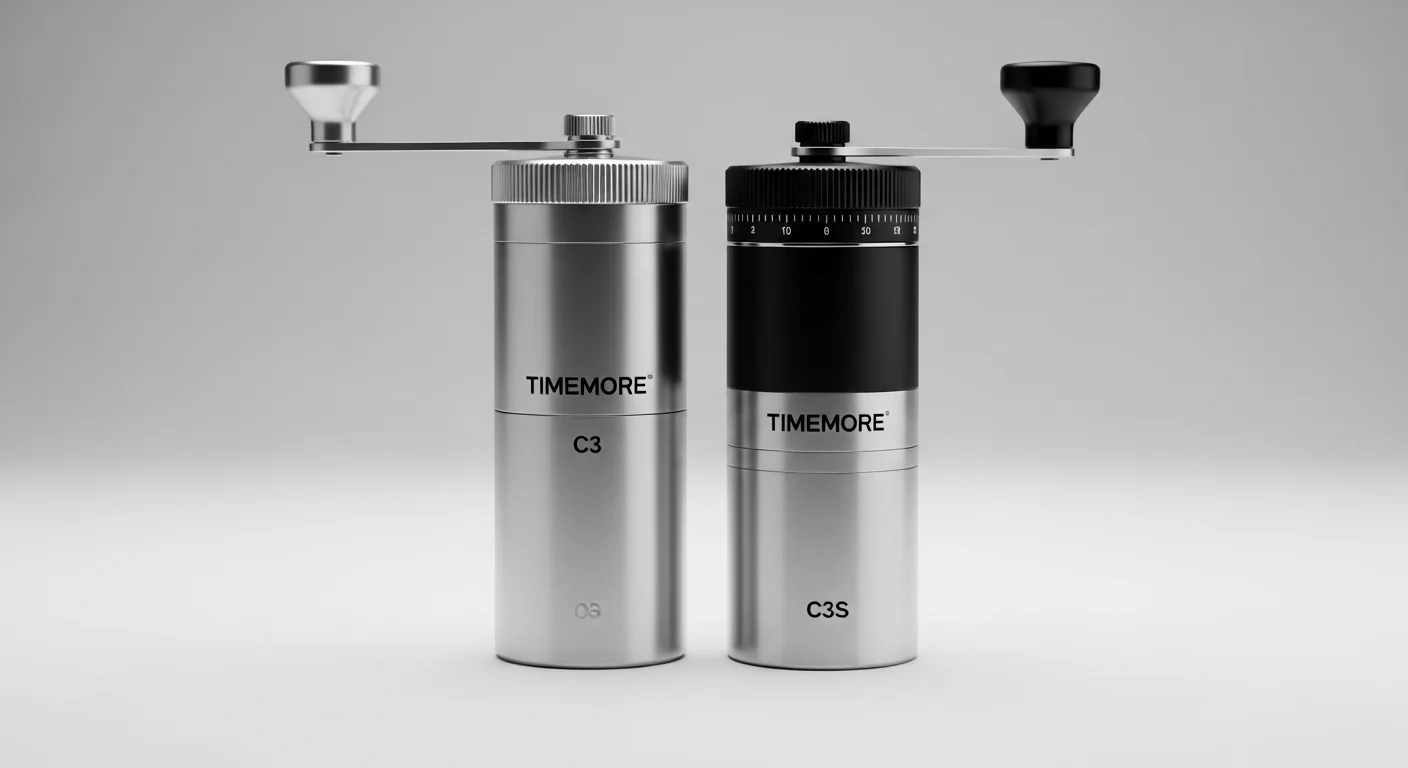
- Timemore C3S (best value manual conical)
- DeLonghi entry electric grinders
Unimodal vs bimodal distribution
Flat burrs tend toward a unimodal (single-peak) particle distribution — meaning most particles cluster around the target size. Conical burrs more often produce a bimodal (two-peak) distribution with more fines alongside larger particles. This is frequently cited as a disadvantage for espresso, where fine particles extract disproportionately fast and can cause channeling. For pour-over and immersion, the bimodal distribution has less impact.
Flat vs Conical: Comparison Table
| Flat Burr | Conical Burr | |
|---|---|---|
| Grind uniformity | High (unimodal) | Moderate (bimodal tendency) |
| Flavor clarity | Sharp separation | Integrated, rounded |
| Heat generation | Higher | Lower |
| Retention | Higher | Lower |
| Grind range | Better for fine/espresso | Better for broad range |
| Price range | Generally higher | From budget upward |
Which to Choose by Use Case
Espresso focused: → Flat burr advantage. Uniformity directly affects extraction consistency at the fine grind sizes espresso requires. Fellow Ode Gen 2 or Niche Zero are the standard recommendations at accessible price points.
Pour-over and immersion brewing: → Conical is sufficient and often preferred. The Comandante C40 and Timemore C3S are the conical manual benchmarks. For electric, the Baratza Encore and similar entry models handle all filter brewing styles well.
All-around, first grinder: → Start with conical. Lower cost, broader range, and lower maintenance. Upgrade to flat burr if and when espresso becomes a serious focus.
Pros
- +Flat burr: superior grind uniformity produces clear, defined flavor separation ideal for espresso
- +Conical burr: lower heat preservation of volatile aromatics, lower retention for single-dose switching
- +Understanding the difference allows matching the grinder to the actual brewing style
Cons
- -Flat burr: higher retention complicates single-dose workflows; higher RPM means more heat
- -Conical burr: bimodal distribution can be a disadvantage for espresso precision
- -Budget flat and conical grinders both have burr precision limits that diminish the theoretical advantages
Final Verdict
Neither flat nor conical is universally superior — they optimize for different priorities. The practical guidance: conical for general brewing and starting out; flat for espresso where uniformity at fine grind sizes directly affects shot quality.
For most home coffee enthusiasts, a quality conical grinder (like the Timemore C3S for manual or Baratza Encore for electric) is the correct first purchase. If espresso becomes your primary focus, a dedicated flat burr grinder becomes a justified upgrade.
Related Articles
- Burr Coffee Grinder Guide — Flat vs Conical Burrs and How to Choose
- Manual vs Electric Coffee Grinder: How to Choose the Right One for You
- TIMEMORE C3 vs C3S — Which Should You Buy?
- 10 Coffee Gear Picks for 2026: The Best New and Notable Home Brewing Equipment
- Fully Automatic vs Semi-Automatic Espresso Machine: Which One Is Right for You?
About the AuthorExpert Reviewed

Coffee Guide Editorial
A team of certified writers and baristas with hands-on experience at origin farms and roasteries. We deliver practical, experience-backed guides on bean selection, brewing methods, and equipment reviews.
Credentials & Experience
- J.C.Q.A. Certified Coffee Instructor
- SCA Certified Barista
- 5+ years running a specialty roasting café
- 200+ coffee beans tasted annually