
AeroPress Championship Recipe Guide: Competition Techniques at Home
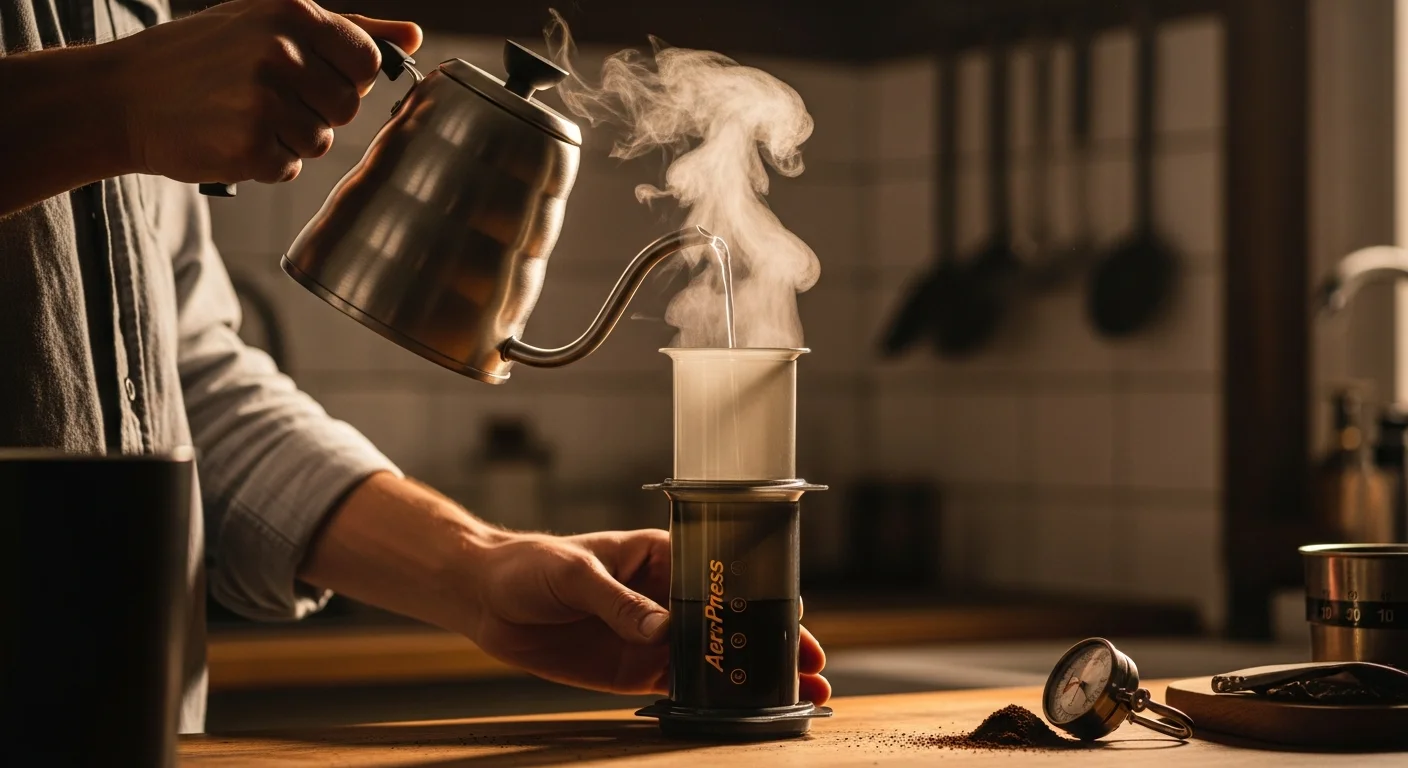
Key Takeaways
- WAC winners often use inverted method, lower temperatures (75–85°C), and higher coffee-to-water ratios for concentrated extraction
- Inverted method allows full control of immersion time; paper filter produces clean clarity; metal filter produces rich body
- There is no single correct AeroPress recipe — the format rewards personal experimentation
The World AeroPress Championship (WAC) has been held since 2008, bringing together competitors from dozens of countries to brew their best cup using a standardized AeroPress. Each competitor develops a unique recipe, and the results are judged blind — meaning the winning technique varies dramatically every year.
What makes WAC recipes interesting is that they reveal the extreme range of what an AeroPress can produce. The approaches used by competitors push well outside the standard recipe — and often produce results that are worth trying at home.
Standard vs. Inverted Method
Before diving into specific recipes, the most fundamental AeroPress choice is orientation.
Standard (Regular) Position
- Cap with filter is attached to the bottom
- Coffee flows down naturally as water is added
- Harder to control immersion time — some drips through immediately
- Simple setup; easier for beginners
Inverted Method
- Plunger faces down; chamber sits upside down
- Water doesn't contact the filter until you're ready
- Full control over steep time — this is why WAC competitors prefer it
- Requires flipping the brewer onto a cup when ready to press
Inverted stability The most anxiety-inducing moment of inverted AeroPress is the flip. To reduce the risk of spilling: after closing the cap, place your cup or server firmly on top, hold both firmly together, and flip as a single unit in one confident motion. Hesitating mid-flip is when spills happen.
Patterns in Championship Recipes
Analyzing WAC winners reveals several recurring characteristics:
Lower Temperature (75–85°C)
This is the most counterintuitive aspect of many championship recipes. The common recommendation for coffee is 90–96°C, but WAC winners frequently brew much cooler.
Why it works:
- Lower temperature extracts fewer bitter, high-molecular-weight compounds
- Sweetness and acidity are emphasized
- Produces a cleaner, more delicate cup
- Works well with the concentrated ratios competition brewers prefer
Higher Dose-to-Yield Ratios
Many competition recipes use 1:10–1:13 rather than the standard 1:15–1:17. This produces a concentrated shot that can be served as-is (for a strong, espresso-adjacent experience) or diluted.
Finer Grind
Fine grind combined with short steep time (1–2 minutes) allows high extraction from a smaller amount of water.
Recipe 1: Clean Style (Standard Position)
A recipe that showcases light roast single origins — bright, clear, and sweet.
| Parameter | Value |
|---|---|
| Coffee | 15g |
| Water | 220ml |
| Ratio | ~1:15 |
| Grind | Slightly finer than medium |
| Temperature | 85°C |
| Filter | Paper |
AeroPress (Clean / Standard)
Total ~2 minutesInsert paper filter in cap; prewet with hot water
Discard rinse water
Set AeroPress in standard position on your cup or server
Add 15g of coffee
Start timer. Pour 50ml of 85°C water
Bloom phase
Stir 10 times in a circle
Wet all grounds evenly
Pour remaining 170ml of water
Total 220ml
Stir 5 more times (0
30–0
At 1
00, begin pressing
When you hear a hiss of air, stop pressing
Hissing means extraction is complete
Serve as-is or dilute with 30–50ml of hot water if desired
Recipe 2: Rich Style (Inverted + Metal Filter)
For medium-dark to dark roasts — full-bodied, oily, and concentrated.
| Parameter | Value |
|---|---|
| Coffee | 17g |
| Water | 200ml |
| Ratio | ~1:12 |
| Grind | Medium |
| Temperature | 78°C |
| Filter | Metal |
AeroPress (Rich / Inverted + Metal Filter)
Total ~2:30Set AeroPress inverted (plunger side down)
Place on a stable surface
Add 17g of coffee
Pour all 200ml of 78°C water at once
Start timer
Stir vigorously 10–12 times (0
00–0
Let steep undisturbed until 1
00
Insert metal filter cap (no prewet needed)
At 1
00, place cup on top and flip in one motion
Begin pressing immediately (1
00–1
Stop when resistance increases sharply
Serve as-is or with a small splash of hot water
Recipe 3: Competition Concentrate (Inverted, High Dose)
The "espresso-adjacent" approach — high dose, low water, brief steep, then dilution.
| Parameter | Value |
|---|---|
| Coffee | 18g |
| Water (extraction) | 120ml |
| Temperature | 80°C |
| Grind | Fine (near espresso) |
| Filter | 2 paper filters stacked |
| After extraction | Add 80ml hot water |
AeroPress (Competition Concentrate)
Total ~1:30Stack 2 paper filters in the cap; prewet both
Double filtering for maximum clarity
Set up inverted
Add 18g of finely ground coffee
Pour 120ml of 80°C water
Start timer immediately
Stir 15 times vigorously (0
00–0
Attach cap; flip onto cup at 0
30
Press from 0
30 to 1
Pour 80ml of hot water into a separate cup first, then pour the concentrate over it
Americano-style dilution
Taste and adjust water amount to preference
Filter Choice and Its Impact
| Filter | Flavor Character | Best Application |
|---|---|---|
| Paper (standard) | Clean, bright, transparent | Light roast, single origin |
| Paper × 2 stacked | Maximum clarity, very clean | Competition clarity, fine grinds |
| Metal mesh (fine) | More body than paper, less than coarse metal | Medium roast, balanced |
| Metal mesh (coarse) | Oily, full-bodied, rich | Dark roast, French press-adjacent |
Swapping filters with the same recipe is one of the most informative AeroPress experiments — the difference is larger than most people expect.
Stirring Technique
Stirring is a significant variable that's easy to underestimate.
Stirring Patterns
| Technique | Effect |
|---|---|
| Circular stirring (10 rotations) | Gentle, even agitation |
| Up-and-down pumping | More aggressive; faster extraction |
| Swirl (no stir) | Minimal agitation; slower extraction |
How Many Stirs?
More stirring = faster, more complete extraction. If your coffee tastes weak, try stirring more. If too bitter, try less stirring.
As a starting point:
- 10 circular stirs after adding water
- 5 more stirs at the midpoint of steep
Why "There's No Wrong Answer"
AeroPress holds a unique position in coffee equipment: the format genuinely rewards personal exploration. The pressure range, the flexibility to use inverted or standard, the interchangeable filters, the extreme range of viable temperatures — all of these mean a recipe that suits you personally is worth more than copying a championship winner.
Start with one of the three recipes above, brew it consistently for a week, then change one variable. Document what you notice. After a month of this, you'll have a recipe that's genuinely yours.
Summary
- Inverted method: Standard in competition; gives full control over steep time
- Lower temperatures (75–85°C): Produces sweeter, less bitter cups
- Paper = clean; metal = rich: The filter choice is a flavor dial
- Concentrate + dilution: Competition-style approach that produces espresso-adjacent intensity
- No single right answer: Experiment and record — that's the AeroPress ethos
About the Author

Coffee Guide Editorial
A team of writers and baristas passionate about coffee. We cover everything from bean selection and brewing methods to café culture.
Team Credentials
- Certified baristas
- Specialty roasting café experience
- Coffee import industry experience