Specialty Coffee Extraction Variables: The 6 Factors That Determine Flavor
PRThis article contains affiliate links

Key Takeaways
- The six extraction variables are grind size, temperature, ratio, time, agitation, and water quality — change only one at a time
- Grind size has the largest single impact on extraction; temperature and ratio follow
- SCA Golden Cup standards define ideal extraction yield at 18–22% and concentration at 1.15–1.35% TDS
If your coffee is inconsistent — sometimes great, sometimes off — the problem is usually that one or more extraction variables are out of control. Identifying which one requires understanding what each variable does and how it interacts with the others.
This guide covers the six core extraction variables and gives you a framework for diagnosing and correcting extraction problems.
What Is Extraction?
Extraction is the process by which hot water dissolves soluble compounds from ground coffee. Not everything in coffee grounds is soluble — approximately 30% of dry coffee mass can be dissolved. The goal is to dissolve the right fraction: the compounds that taste good, not the ones that taste harsh or hollow.
SCA Golden Cup Standards
The Specialty Coffee Association provides reference values for well-extracted coffee:
| Metric | Ideal Range |
|---|---|
| Extraction Yield (EY) | 18–22% |
| Total Dissolved Solids (TDS) | 1.15–1.35% |
| Brew Ratio | 1:15–1:18 (coffee:water) |
These numbers are useful reference points, not absolute rules. They represent the center of the "tastes good" range for most coffees and most palates.
Variable 1: Grind Size
Impact Level: Highest
Grind size controls surface area, which controls extraction speed and yield.
- Finer: More surface area → faster, more complete extraction → more bitterness and body
- Coarser: Less surface area → slower, less complete extraction → more acidity and brightness
The Core Adjustment Rule
Too bitter → go one step coarser
Too sour or thin → go one step finer
This rule solves the majority of common extraction problems.
Change only one variable at a time If you change grind size and temperature simultaneously and the coffee improves, you won't know which change caused it — or what to do when it goes wrong again. Systematic single-variable testing is the foundation of consistent brewing.
Variable 2: Temperature
Impact Level: High
Water temperature affects which compounds dissolve and how quickly.
Higher Temperature (92–96°C)
- Faster extraction
- More bitter and high-molecular-weight compounds dissolve
- Better for dense light roasts that resist extraction
Lower Temperature (85–92°C)
- Slower, more selective extraction
- Sweetness and acidity come forward
- Better for dark roasts where bitterness is already easily extracted
Roast-Specific Recommendations
| Roast Level | Recommended Temperature |
|---|---|
| Light | 92–96°C |
| Medium | 90–93°C |
| Medium-dark | 88–91°C |
| Dark | 85–88°C |
Temperature Management Without a Thermometer
- Boiling water cools approximately 2–5°C per minute with the lid off
- 1 minute off boil ≈ 95–97°C
- 2–3 minutes off boil ≈ 90–93°C
- Pouring into a preheated vessel minimizes temperature loss during brewing
Variable 3: Brew Ratio
Impact Level: High
Brew ratio is the weight of coffee relative to the weight of water, expressed as 1:X (coffee:water).
SCA Recommended Range
- 1:15: Strong, high TDS
- 1:17: Standard, balanced
- 1:18: Light, lower TDS
What Ratio Changes
Ratio directly determines concentration (how much dissolved coffee is in the liquid). It doesn't change what compounds are in the cup — only how diluted they are.
| Ratio | Character |
|---|---|
| 1:12–14 | Very strong — espresso-style |
| 1:15–16 | Full-bodied, concentrated |
| 1:17–18 | Balanced, standard |
| 1:19–22 | Light, transparent |
The Role of a Scale
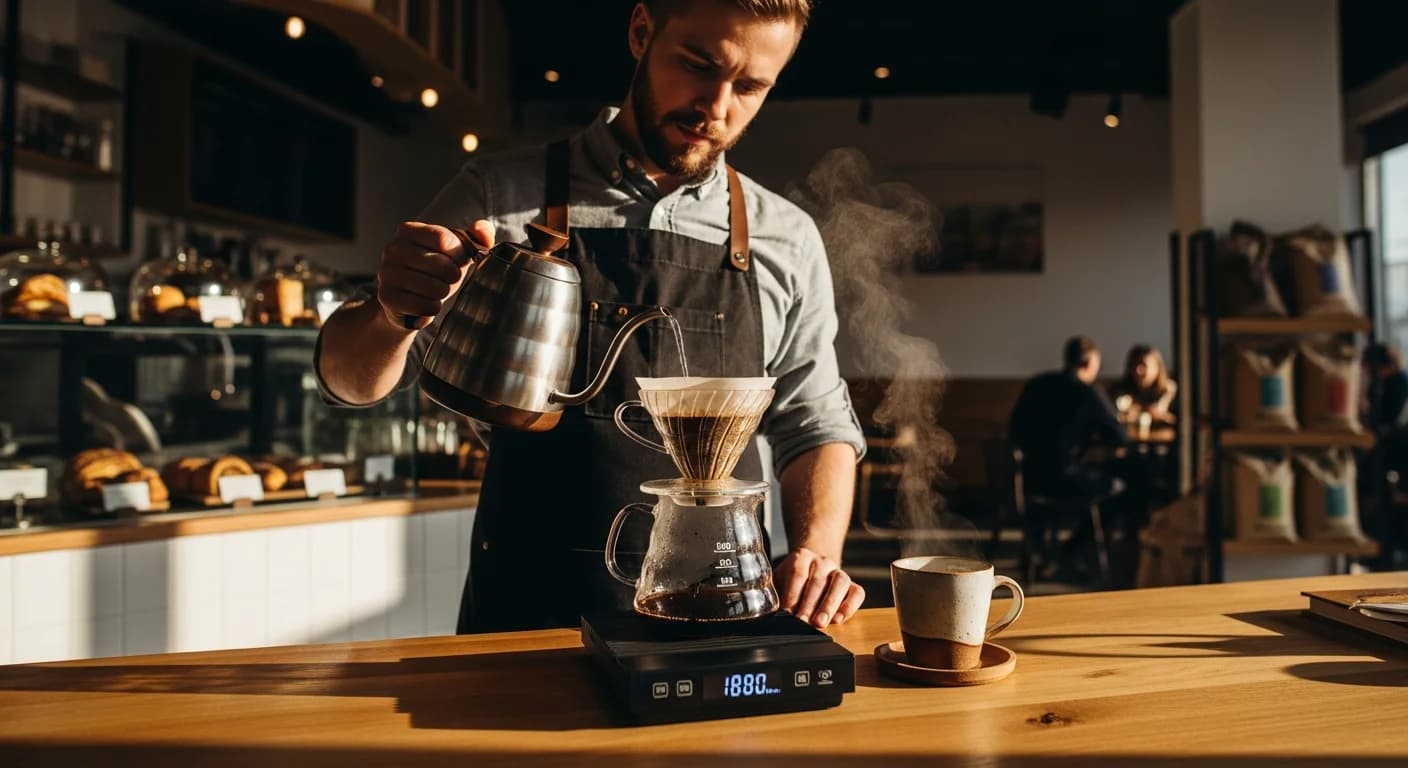
Consistent ratios require weighing your coffee and water. Scooping introduces 10–15% variability that makes it impossible to diagnose extraction problems. A scale is the single most important piece of equipment for consistent brewing.
Variable 4: Contact Time
Impact Level: Medium–High
Contact time is how long water and grounds are in contact. Longer time = more extraction.
Standard Times by Method
| Brew Method | Target Time |
|---|---|
| Espresso | 25–35 seconds |
| Pour-over (V60, Chemex) | 2:30–3:30 |
| AeroPress | 1–3 minutes |
| French press | 4–5 minutes |
| Cold brew | 12–24 hours |
Controlling Contact Time
- Pour-over: Grind size changes flow rate (and therefore contact time)
- French press: Timer controls steep duration before pressing
- AeroPress: Press timing determines contact duration
Variable 5: Agitation
Impact Level: Moderate
Agitation refers to any movement of the grounds or slurry during brewing. More agitation accelerates extraction.
How Agitation Works
Coffee grounds naturally form channels where water flows preferentially. Stirring disrupts this channeling and promotes even extraction. But excessive agitation can also disturb fines that clog filters or create bitterness.
Method-Specific Approaches
| Method | Agitation Approach |
|---|---|
| Pour-over | Gentle swirl after bloom; Rao spin at the end |
| French press | 1–2 stirs before pressing |
| AeroPress | 10-second stir with a spoon |
| Cold brew | Initial stir only; leave undisturbed during steep |
The Rao Spin Popularized by Scott Rao, the Rao spin involves gently swirling the dripper at the very end of brewing to knock grounds off the filter walls. This promotes even bed formation as the final water drains and is associated with improved extraction uniformity. Not every brewer uses it, but it's worth experimenting with.
Variable 6: Water Quality
Impact Level: Often Overlooked
Water is 98–99% of your brewed coffee. The mineral content of your water is not passive — it actively participates in extraction chemistry.
SCA Water Standards
| Parameter | Recommended Value |
|---|---|
| Total Dissolved Solids | 75–250 mg/L (ideal: 150) |
| pH | 6.5–7.5 |
| Alkalinity (bicarbonate) | 40–70 mg/L |
| Sodium | ≤10 mg/L |
| Chlorine | 0 mg/L |
Mineral Effects
| Mineral | Effect on Coffee |
|---|---|
| Magnesium (Mg) | Enhances extraction of organic acids and aromatics; increases perceived complexity |
| Calcium (Ca) | Assists extraction of bitter compounds; high levels promote over-extraction |
| Sodium (Na) | Low levels enhance sweetness perception; high levels create a salty character |
| Bicarbonate | Buffers acidity — too much produces flat, dull coffee |
Practical Water Choices
| Water Source | Quality | Notes |
|---|---|---|
| Filtered tap water | Excellent | Removes chlorine; retains minerals |
| Soft mineral water (75–150 mg/L) | Very good | Most widely available |
| Hard mineral water (>200 mg/L) | Variable | Can produce flat or harsh coffee |
| Distilled water | Poor | No minerals; extraction suffers |
Variable Interactions
The six variables don't operate independently — they interact.
Common Interactions
- Finer grind → slower flow → longer contact time (for pour-over)
- Higher temperature → faster extraction → same as going slightly finer
- Changing ratio changes concentration but not extraction yield
A Systematic Adjustment Framework
Step 1: Set ratio first (1:16–17 as default)
Step 2: Set temperature for roast level
Step 3: Calibrate grind size to hit target brew time
Step 4: Adjust agitation if extraction is uneven
Step 5: Address water quality last (fix and leave fixed)
Summary: Priority Order for Adjustment
| Priority | Variable | Adjust When |
|---|---|---|
| 1 | Grind size | Every new bean or when taste is off |
| 2 | Ratio | Adjusting overall strength |
| 3 | Temperature | Changing roast levels |
| 4 | Contact time | Confirming grind adjustments |
| 5 | Agitation | Locked in once recipe is dialed |
| 6 | Water quality | Fix once and keep consistent |
Understanding extraction variables transforms troubleshooting from guesswork into logic. When coffee tastes wrong, you can identify which variable is likely responsible and adjust it directly — rather than changing everything at once and ending up more confused than when you started.
Related Articles
- How Coffee Grind Size Affects Taste: A Grind-to-Flavor Guide
- Coffee Water Quality Guide: How Water Chemistry Affects Your Brew
- How Water Temperature Affects Coffee Flavor: Finding the Optimal Range
- Pour-Over Coffee Timing Complete Guide: Bloom, Pours, and Extraction Time
- Why Is My Coffee Too Bitter or Too Sour? Causes and Fixes
About the AuthorExpert Reviewed

Coffee Guide Editorial
A team of certified writers and baristas with hands-on experience at origin farms and roasteries. We deliver practical, experience-backed guides on bean selection, brewing methods, and equipment reviews.
Credentials & Experience
- J.C.Q.A. Certified Coffee Instructor
- SCA Certified Barista
- 5+ years running a specialty roasting café
- 200+ coffee beans tasted annually